
Insane Hydraulics
Bold and audacious blog about fluid power
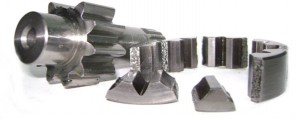
With the strangest wear patterns documented and put to rest, I can finally concentrate on the true star of the show - the Kawasaki K5V80DTP - a tandem 80cc pump that is a hydraulic heart of many medium-sized excavators with "Oriental origins."


For some unknown reason, I really like these pumps - and I am saying this with my hand on my heart. A mechanic is not supposed to like this model, because it is not the easiest of pumps to work on, so I must have gone though enough of those to have acquired a taste or something. In any case, since it requires "extra attention to detail" during an overhaul, it is a perfect example of a unit that has a high probability of suffering from a repair technique that I like to call "fast but slacked."
Let me explain what I mean by that - and no, this is not going to be an article on how our shop provides stellar repairs while everybody else slacks and sucks - it's going to be more like a justification coming from an experienced slacker who eventually found his ways.
So, picture the following - you get this unit for an overhaul, you crack it, you see that it requires lots of new stuff: complete rotary groups, bearings, swashplates, etc... but the controls worked fine before the pump was removed from the machine, and every o-ring you touch seems "still springy" - so at a certain point you look at those control modules, and a thought crosses your mind - "The o-rings are not too shabby, are they? Do I really have to open them controllers and reseal them? Maybe I can just clean them up real good, fit the interface o-rings, and be done with it in a jiffy!" The temptation is so-o-o strong! Especially if you envision all the parts that you will have to remove and (tediously) clean one by one (I call this picture "Welcome to my office!"):

And if you fall to this temptation, a "fast but slacked" overhaul is born! The problem with such overhauls is - you do get to win multiple times in a row before you inevitably lose. And by lose I mean deliver a sub-par repair that comes back to bite you on the... pilot pump.
My opinion on hydraulic repairs is well known - you don't cut corners no matter what, but - oh brother - do I feel the urges to slack off and take a shortcut on virtually anything I get to work on! And I know how to do it very well, too! Slaking off, I mean. But I also found a solution, or a method, if you will, to keep my "slack hankerings" in check, and it goes like this - I set up the environment so that there's nothing unrelated to the current repair, and then I imagine myself a skilled craftsman working on a piece of art, or... since I'm using a Japanese pump here - a swordsmith forging a katana sword. I thoughtfully clean the parts one by one, then carefully lay them out on top of shop towels. Even the tools that I am using I try to keep neatly placed on top of the bench like surgical instruments next to an operating table. The idea is to turn the repair into a beautiful craft rather than a tedious chore. Convert your work area into a zen garden (of sorts). And when I enter the "zen state" - I don't get overwhelmed by the amount of parts I need to shovel through with a brush, a scraper, and a scotch-brite - I simply work them one by one till there are no more. And then I move to the assembly in the same manner.


If you can afford to work like that, or if you oversee other mechanics, and you can create this culture and, of course, provide the necessary conditions, the quality of your repairs is guaranteed to be top-notch.
And now, let me demonstrate a couple of concrete places where slack may happen on this particular model, and also share a couple of tips/thoughts while I do that. And naturally, since this model is known as "the pump of a thousand o-rings", I will start with the seals.
Before anything else, it is important to note that this unit is a child of the Japanese school of engineering, and it is only natural that it's using seals that conform to the Japanese industrial standard for o-ring sizes designated as JIS B 2401. If you, like us, mostly use o-rings of the "AS568" variety, the seals from your "emergency o-ring stock" will be mostly useless thickness-wise, especially for smaller sizes (where you get the Japanese 1.9 or 2.0 vs 1.78 or 2.4 vs 2.62). We can actually get very decent and very complete seal kits for the Kawasakis around here, but I sill like to have some extra Japanese o-rings handy in case I lose or pinch a seal (especially the P8s).
My first "Kawasaki seal advice" is - spread all the seals from the seal kit on a couple of shop towels, and arrange them by size, and if you want to go an extra mile, take your vernier calipers, print out a B 2401 o-ring size table, and then measure the o-rings and mark the sizes, like so:


You will get acquainted with the JIS standard, and you will also realize that the numbers are boss-based, meaning you will be most likely picking a Nº16 o-ring for a 16 mm boss:

This process ensures you select the right o-ring quickly and without any guesswork.
Now, let me show you the three places where the "seal slack" usually happens when the controllers are resealed. First - it's the toque limiter adjusting screws, which carry two o-rings that are often "omitted" during a re-seal:


I often hear an excuse that goes like this: "removing the adjusting screws could spoil the correct toque limiter setting" - and you would be right, it could, but there's an easy way to make sure the screws return to exactly the same position as they were before the disassembly - all you need to do is loosen the safety nut on an adjusting screw (I like to start with the smaller one), and then unscrew (turn it to the left) till it bottoms out, while counting the revolutions - it's going to be something like 1.7 or, say, 2.6 turns. Then you write this number down, and now you can remove the screw by turning it all the way in until it falls out. The idea is - the bottoming out is a hard reference point, so when you put the screw back in, all you need to do is unwind it till it hits the end of travel, and then screw it back in a known amount of turns (this number is usually small). I like this way better than measuring the height of an adjusting screw above the control surface - it works, kind of, but it does not offer too much precision, IMO.
So, where was I? Oh yes - the slacked controller resealing. The second place would be the two pin plugs on the side of the controller, which are also, quite often, left with the old o-rings:


The problem with these is - if it's a fist overhaul (sub 10000 hr) of a unit, keeping the original o-rings on the pins works, but after some 10000-15000 hours, especially if the pump overheated before, the o-rings become pretty hard, and a newly rebuilt pump can start to "bleed" from these pins, which is unacceptable. Also - replacing these o-ring in the field is not fun at all - I've done it, and you can guess the reason why...
There's one more hidden o-ring in these control modules that can get overlooked - the o-ring that sits in the groove of the torque limiter piston sleeve:


It's hidden from sight, and you need to push the sleeve out to get to it - something that "professional slackers" never do!
As an honorable seal-related mention, I would also like to point out the numerous ORB ports, which also should be resealed, which is another reason to stock on JIS o-rings beforehand, because the kits usually don't carry all the o-rings for the ports, and you get quite a few of these in this pump.
Another place to "slack" is the mesh filters, which should ideally be removed and inspected/cleaned on every overhaul. I bet the hands-on folks reading this are asking. "Why do you say mesh filter-s? There's only one, and it is located in the pilot pressure pump!"

You are right, but don't forget about fittings that can fool a hydraulic technician! Quite often, OEMs use them on excavators, and in this particular Hyundai, you will find them in the pilot pressure fittings:

What else? Oh yes - the rotary groups alignment! You can slack off and slap the two halves of the tandem together in a random position, or you can take an extra minute to align the pistons of the two rotary groups in an alternating fashion, which, at least theoretically, should improve the sound profile. In my experience, none of the pumps that were mounted "randomly" ever came back because of that, but, you know, if you can make it better - make it better, right?
Another thing just popped up in my mind - a minor detail - when you reassemble the pilot pressure gear pump, you may notice that, unlike "normal" gear pumps, this one does not have any alignment pins, and the screws allow for a certain play:

So, if you are not careful, you can misalign the halves of the pump, and this can be felt by rotating the shaft, which will become a bit stiffer. Not a big problem because the gear pump works at a very low pressure (of about 35 bar), but if you hand-tighten the bolts and then tap on the end cover of the gear pump and align it into the position where the rotation of the input shaft feels smother - and only then tighten the bolts with the final torque, you will be better off for sure.
So - there you have it. Slacked repairs - they are fast, but they are bad, so do your best to enter the zen state and deliver the best overhaul possible
P.S.
And now it is time for the postscript. I just said that I liked to turn my working area into a zen garden - and I didn't lie - I truly like it! But, unfortunately, I never can. Here's how it goes for me: I put my gloves on, get into the zen state, and begin scraping a part in the parts washer. I carefully clean it, shine it, blow it with compressed air, and lay it over a carefully arranged shop towel. Pure perfection. Zen music already ringing in my ears, a reach for the next part... and boom! The telephone rings - and I need to go back to the office to take care of an urgent quote. Then I come back ten minutes later, spend another five minutes to get back into a zen state, and... boom! - There's a client at the counter with an old hose - and I go and crimp a new one for him. Then I get back to the parts washer, and as soon as I put my gloves back on - boom! Another call/urgent e-mail, somebody looking for a new pump. etc... I suppose the biggest perk of a small crew is you get to grow the thickest of skins! But you can also forget about doing something uninterrupted from start to finish - so, if you have mechanics working for you, make sure that when you give them a task, they don't start another until they finish this one! (In other words - keep their zen garden intact!)
And what happens if they don't? Well - here's an example, and I will even use the same very pump. I did my absolute best to enter the zen state and replace each and every freaking o-ring with care, and yet the mechanic who installed it on the excavator (luckily a friend of mine) called me and said: "Mate, check out the WhatsApp message I just sent you":


I looked at these marvelous images and said: "I'll be there in ten minutes!" Here's the o-ring that I somehow pinched (the black one - I ran out of the brown ones...):

I suppose this kind of proves my point - an uninterrupted zen state repair is perfect for getting perfect overhauls, and anything less than that results... well... in exactly what you see above - a slacked repair! I still can't believe I did that!
P.P.S.
If you wonder why the pinched o-ring was not detected during a test, this pump was not tested - it went straight to the excavator from my operating table (there was, of course, a reason for that).