
Insane Hydraulics
Bold and audacious blog about fluid power
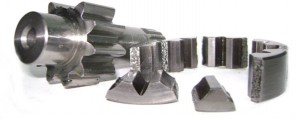
Today, I'm kicking off the first of two articles focused on a recent Kawasaki job. This post actually emerged as I was writing a completely different blog about the pump that I overhauled this week. As I reviewed the parts, the wear pattern struck me as odd, and the more I thought about it, the weirder it seemed. I felt I had to analyze and discuss this specific failure before moving on, so I've postponed the originally intended article until next week.
Let us begin with the breakdown. This is a tandem unit - K5V80DTP1J9R-9N35 - from a Hyundai Robex180LC-9A excavator:

The symptoms appeared right as the counter hit 7000 hours - an abnormal noise, strong vibrations in one of the pressure hoses, and soaring oil temperatures. When the mechanic called me, I asked for more detail, and once he confirmed the vibrations were isolated to a single pressure outlet and that their intensity scaled with pressure and their frequency with RPM, I knew we had a rotary group failure. The excavator was immediately parked and the pump removed and delivered to our shop for inspection. Nothing too special so far - I see variations of this story every single week.
The source of the vibrating pressure hose was immediately clear once I opened the pump's front section - one of the bores of the cylinder block got ... "overplayed" (meaning it developed a clearance that was "slightly higher" than normal):


Typically, 7000 hours is too early for a K5V to fail, especially when the machine is well-maintained. What truly surprised me, however, was that only one single piston had developed this "super play." I've definitely seen this before, but it's a rare occurrence - the wear is usually spread uniformly across all components of a rotary group. Here, the contrast was stark - the other pistons had scratches, yes, but absolutely zero excessive play.
Honestly, I still don't have a reasonable explanation for this. Perhaps it was a single "event," like an especially large particle damaging that one piston so badly that it started to file its bore out of existence. Or maybe there was a manufacturing defect in the barrel? Since the excavator worked for over 7000 hours before this occurred, any defect should have manifested sooner. Regardless, the play is massive: a 20mm bore got ovalized to 21.5mm! My text editor suggests replacing "ovalized" with "vandalized" - and honestly, it's not entirely wrong, is it?
This is the part that got me thinking the most. Initially, I disassembled the unit, found the bad piston, and noted the scratches on the sides of the remaining pistons. I didn't think much of it at the time: a damaged component creates metallic shavings, and these shavings then scratch adjacent parts - that's a given, right? So, I took some pictures of the parts and set them aside.


But then I noticed the pattern - the pistons had angled scratches on both the top and bottom, separated by a clean, un-scratched band in the middle. Furthermore, the scratches all spiraled in the same direction. There's so much weird about this that I don't even know where to start, but I'll do my best to explain what I mean. And for the record, if you just thought - "The only weird thing about this is him spending time thinking about piston scratches" - I totally agree!
The scratches near the piston shoes are the easiest to explain. Hard particles, shed from the damaged bore, get carried away by the case oil. These particles then randomly enter the bore gaps of adjacent pistons, where they temporarily lodge themselves into the softer barrel material, and as the pistons move in (the pumping stroke), the particles scratch the piston sides, and then they are expelled during the outward suction stroke.
The fact that the scratches are angled in only one direction suggests the scratching was happening only during the pumping stroke. This is why I state that the particles were being expelled during the suction stroke. If the debris had been permanently embedded into the barrel walls, the angle of the scratches would have reversed as the pistons moved out.
By the way, the scratch angle clearly reveals the barrel's rotation direction. Typically, pistons in a swash-plate pump rotate in the direction counter to the barrel. If you look at the picture and imagine the scratches as screws, they are left-threaded. This tells us the barrel was rotating to the right (viewed from the ball-guide end). Knowing how a tandem K5V is constructed, you can actually conclude these pistons came from the front (right-hand) rotary group just by looking at the scratches!
But there's more to the scratch angle - I find it to be excessively steep! I get scratched pistons in axial units all the time, and typically, the wear marks are nearly parallel to the piston axis. This is because the pistons rotate in the bores, but very slowly. To illustrate - here is an example of a pump that developed similar "super play," and here you'll see another pump where the parallel scratches were spaced so closely they turned into tiny diffraction gratings.
The steep angle of these scratches suggests the pistons were rotating quite fast, and the reason is a complete mystery to me. Could some particles have entered the piston/shoe ball interfaces, "blessing" them with increased friction? I'm not certain, but the evidence of the large angle is right there. In fact, on some pistons, you can see not one, but two different scratch angles. At this point, I have no explanation for this.
But... there' still more, for so far we looked only at the shoe ends of the pistons. Now, let us look at the


I can see how hard particles suspended in case oil can get to the shoe ends and do the damage, but how could they "swim around" and reach the other end of the tight barrel bore?

The only reasonable explanation I can think of is that the super-play bore was somehow actively transporting particles across the transition zone from the pressure side to the suction side. Nothing else makes sense to me.
Now, If you asked me how the particles suspended in the suction oil would scratch the piston noses, I would probably suggest an action similar to the one I just described for the shoe ends - the scratching action happening as the piston enters the bore, which for the nose end of a piston would mean the suction stroke (nose end sliding into the bore as the piston is being pulled out of the barrel by the shoe from the other side). But if that was true, the angle of the scratches should be reversed, because the pistons always rotate in the same direction (in relation to the bores) - and that is not what we see here - both the top and the bottom scratches are angled in the same direction! For me, this can only mean one thing - the scratches at the nose ends were also occurring during the pressure stroke.
I have no idea how this could be happening and why the particles weren't removed (pushed out) from the gap by the piston moving out. I suppose the pressure differential was somehow keeping them in the gap? But it is either that, or the pistons can somehow alter the direction of rotation on every turn, which seems impossible to me.
Also, the surviving bores were scratched, but less than one would expect (it is actually quite hard to take a decent picture of a bore):


There's one last thing I want to talk about - the shoe retainer plate:


It cracked, but it didn't break. This is pure luck right there! I think they stopped just in time. Had it been for several more minutes, they would have been fishing for bits of rotary group from the drain lines. Unfortunately, there's no record of how long the excavator worked when the first symptoms appeared, so I don't even know if this damage took days, hours, or minutes to develop.
I imagine those of you who know these pumps are wondering how the second half of the tandem fared. Well, much better, but it still appears that a couple of hard chunks from the front found their way into the back and scratched a single piston, only at the shoe side (See? Once again - a single freaking piston! Purest of sorceries!)


This is the only damage the tail rotary group got. Note that the scratches are right-handed on this side, which kind of proves my direction of rotation theory (the tail rotary group is facing the other way, in case you wonder). You can also see that their angle is much less aggressive, which means that the pistons of the tail group were rotating much more slowly in their bores.
So, I already got the parts, I'll rebuild the pump, and it'll be like new. And since I am, honesty, not sure on what to make of all this "strangeness", I'll document it here, in hopes that some of you, my fellow hydraulic brethren, share your thoughts on how a single piston/bore interface can fail so miserably, and how the scratchy particles can find their way to the other side of the bore and then scratch the pistons in the wrong direction, while revving them up in their bores!