
Insane Hydraulics
Bold and audacious blog about fluid power
Today I want to report on an investigation that I had to perform "remotely" (over the phone and other means of communication), which was quite unfortunate, because the troubleshooting case was really... I think I'll use the word... intriguing, because if my suspicions are correct, I'll never look at inlet modules of Danfoss PVG32s in the same way again.
I was reluctant to make this post because I don't yet have all the data to support my current theory, but in the end I decided that I should put what I learned so far in writing, and then later devise a test to validate or, maybe, disprove my "so-far assumptions." If I don't log this now, I'll probably end up forgetting about it (like I always do).
So, here it goes. A client of ours acquired a second-hand hydraulic winch for their vertical shaft lining robot, and the winch had to be transformed to satisfy the extremely low-speed demand of this peculiar operation. These concrete sprayers need to be raised at very steady and very low speeds, often in the order of mere centimeters per minute, and standard hoist winches can't reliably support such low speeds and provide the necessary control precision.
The transformation consisted of adding an additional reduction stage coupled to a negative brake, and it worked great. The gearbox was driven by an OMVS 315 orbital motor, which in its turn was controlled by a single-section Danfoss PVG32 with a 25 l/min spool and a low-hysteresis PVEH proportional actuator, which gave this system an absolutely perfect low-speed control.
Unfortunately, the top speed was ridiculously slow, and while it was good for spraying concrete, it was unacceptable for operations in longer shafts, and so I was asked to devise a way to upgrade the HPU so that the winch could run faster when needed.
My solution was simple - I replaced the single group 2 gear pump with a group 3 + group 2 aggregate (58 cm³ + 19 cm³), beefed up the electric motor to 37 kW, and added a second section for the PVG32 for high-speed control and a solenoid-operated diverter valve to disengage the big pump when it was not required (obviously with an open-center transition). I also upgraded the return filter and added an air-oil cooler. I got the parts and the client's very capable shop did the upgrade. Here's the hydraulic diagram that represents the upgraded system (the cooler's missing, but you get the idea - small pump + 25 l/min spool for fine control, both pumps + both spools at the same time for high speed):

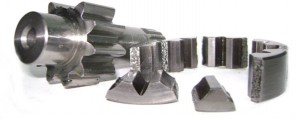
The new system passed all the tests with flying colors, but a couple of days after it arrived at the job site, it stopped working completely, and the tech who went to "investigate" sent me the following picture:

The pump shaft key got sheared off (unfortunately, the key leftover was removed before this picture was taken)! Something like this should never happen to a new system, but it did! Now, in such cases when you have a diverter valve mounted at the outlet of a fixed-displacement pump, it naturally is the suspect number one, but I can give you a 99.999% guarantee that the diverter valve had an open-center transition (because I personally checked this before delivering it to the client), and I can also guarantee that the relief valve of the inlet module of the PVG was set to a normal pressure value (180 bar).
It is clear to me that the key was sheared off by the pressure spikes in the outlet of the larger gear pump, and later we also discovered that the diverter valve was cycling more often than needed - its coil was powered from the power bus of the PVEH actuator, and when the high-speed mode was active, it would switch off every time the joystick returned to the neutral position, which was completely unnecessary. But even so - the pressure spikes were not supposed to be happening!
The diverter valve is open-center, I have used this model before and I never had pressure spike issues.
The open-center inlet module of the PVG32 is already in the open position when the flow from the big pump is added to the flow of the small pump, so the pressure bump shouldn't be aggressive enough to shear off a solid steel key. And yet, it totally did!
The way I see it, there are three possibilities:
So, the shaft key was replaced, and the lining job (luckily it was a relatively small shaft) was finished with the diverter valve solenoid disconnected. When the HPU got back to the shop, I advised installing a fast-acting relief valve at the inlet of the diverter valve. I set the cracking pressure of the valve to 200 bar and sent it over to the client, and asked the mechanic to inspect the discharge line of the relief valve when the diverter valve was energized and de-energized. He told me that they indeed were detecting short bursts of oil every time it was switched on. The control was also changed so that the diverter coil would be either turned on or off permanently.
As soon as I have some time and an open-center PVG32, I will attempt to simulate the instant flow-boost on our test bench to see if/how high the inlet pressure spikes. Honestly, this case reminds me of my Travelift adventure, when PVG32-related pressure spikes split open a multi-section gear pump I was working on.
In any case, so far my takeaway is, from now on, to never omit a relief valve in a diverter-valve-based flow-boosting circuit when it is feeding a valve with a compensated inlet module:

Stay tuned for those tests!