
Insane Hydraulics
Bold and audacious blog about fluid power
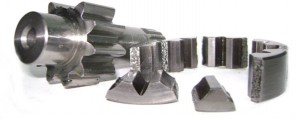
In light of recent events (details of which, unfortunately, I am not at liberty to discuss), I want to revisit (and reinforce) the very important subject that I already talked about in the article called "When in Doubt Bleed it Out!" (link at the end of this post). There are three points on today's agenda:
1) I want you to become permanently divergent from everybody else and feel a reflexive burst of angst as soon as you hear (or even think) about the most routine and innocent hydraulic maintenance procedure in the world - the oil change.
2) I want to discuss a valid but peculiar (if not treacherous) suction line design that is often used in large industrial HPUs and the potential inconvenience in the form of a catastrophic pump failure that it can cause to "unaware end users" after a simple oil change.
3) I want to propose solutions to mitigate this problem.
This topic is so near and dear to me that I, honestly, want your life as a hydraulic technician to be split into "before" and "after" reading this article, so, please, hear me out, this is a big deal!
What is the most common mechanical device in the world? It is an automobile. And what is the easiest and most common maintenance procedure in the world then? An oil change, of course! This notion is imprinted in our minds so strongly, that we subconsciously regard an oil change as the simplest of tasks. But I don't want you to think like that anymore. You're not a "normie", you're a hydraulic professional who should know better, and when you hear "Old oil out, new oil in, good to go!" you should immediately say "No! No good to go! Me check first - then good to go!"
This is the one industrial maintenance step that you must nail down and keep forever in your mind as a "potential pump killer" - and when you arrive at an industrial installation and discover that an oil change was just performed you should never think "How nice! They changed the oil!", but rather "Oh my God!!! They changed the freaking oil!!!"
Naturally, you may hear something like: "...What are you so stressed out about, dude? Just look at our HPU! There's, like, two meters of oil head above the obviously flooded pump inlets, and the pumps have displacements of hundreds of ccs, so they will surely suck out whatever air there may be left in the suction lines. Check out the pipes - they're, like, 6 inches wide, man, so just relax, it's going to be fine!.."
And to this, my "very relaxed industrial peer", I have two things to say: first - your seemingly flooded pump inlets may actually be not flooded at all, even with the ginormous oil head above them, and second - did you check the starting pressures of all of your pumps? Are you sure that a pump can suck an air pocket out of the suction line if it needs to build at least 30 bar in its outlet in order for the pumping action to happen? Made you think now, didn't I?
Let me explain one thing at a time now.
First - about the suction line design. There are truly flooded inlets, and there are what I like to call "pseudo-flooded inlets". These inlets are used for connecting pumps that are external to the oil tank, and they look absolutely flooded from the outside, but as soon as you peek inside the oil tank - you see why they are "pseudo-flooded":


The picture shows a tank that holds some 4000 liters of oil and as you can see the designer opted for installing these nice 90-degree bends on all of the suction lines (there are 6 suction lines in the picture, and all of them have the elbows). I can see the reason for the elbow on the longer pipe to the right, but honestly, the five lines in the bottom could have been straight, IMHO. Do they secure proper suction line function? Absolutely! But they will also secure an enormous air pocket on every oil change!
Second - the question of the pump sucking the air pocket out. Usually, it can do that, albeit at the cost of a few seconds of marginally lubricated operation, but there's one particular scenario when a pump can not get rid of the air pocket by itself - this happens when some pressure is required to build in its outlet in order for the "flow to happen". Like two independent pumps feeding the same pressurized line, or a single pump that is connected to an "initially closed consumer", like a priority valve, an inlet of a proportional DCV, or an accumulator charging circuit:

In such a system a pump is not able to create enough pressure with just air, and so it runs dry until somebody notices the burning smell and says "Oh.. so that's why the rig is not running straight!" Then the production is stopped, and they wait for weeks for a new pump to arrive (because ever since the corona hit us not even the OEMs stock pumps anymore), and then the cycle repeats itself until someone finally realizes that they must bleed the air from the damned inlets every time they change the oil!
So - here's the recipe for the most innocent-looking hydraulic pump killer in the world - a pseudo-flooded suction line coupled to a system that requires a pump to build positive pressure as soon as it starts turning.
What can be done about that then?
I can think of two approaches - the mechanical and the informational.
First - the mechanical - i.e. a system that is built in such a way that an air pocket in a suction line can not develop at all or the pump can expel it without any external help. HPU designers, please, think twice before you bend a horizontal suction line down and then hide it inside a tank! If you can use a straight pipe run - do it! This is the best solution, in my opinion - a suction line that has no place for air pockets to form in the first place. But what if you decide that the bend is needed? Then see if it is possible to provision for a small air-bleeding hole at the top of the suction pipe (obviously inside the tank and obviously if it is flooded at all times), or, as a last resort - install an air bleed valve at the pump outlet.
But what if you can't (or won't) do any of the above, or you are facing a system that is already built that way? Then your only weapon would be the "informational approach" - i.e. making sure that the need for mandatory bleeding of the suction lines after an oil change is "painfully obvious". You know, just like with airplanes - the red "remove before flight" tag is used even when everybody knows that a pilot tube must be uncovered before a flight. So, my suggestion is - highly visible tags or warning signs that state something like:
"Warning! Bleed this suction line after an oil change. The pump is not self-priming and will be permanently damaged if the air is not removed from the suction line!"
I would also suggest putting such signs in the electric cabinet and the place where the HPU is started manually for maintenance purposes, and, if possible, include this warning message in the starting screen/maintenance mode screen of the PLC that controls the HPU.
To conclude:
P.S.
I suggest you do the following mental exercise: Imagine that you arrived at a large production facility to run some tests on a large HPU, and were told that it was "all ready to fire up", and that the maintenance crew had even changed the oil and the filters for the tests to "run smoother". Then you run your tests and realize that the system has a fault, and apparently a big one. So, as the professional hydraulic troubleshooter that you are, you run some more tests, and the clues eventually lead you to a hydraulic pump that is "suspiciously hot", and it is only then that you realize that you should not have put that much trust in the maintenance crew and should have verified for yourself that the suction lines had been bled... Imagine how would this feel! Not too good, right?
P.P.S.
Now, if you enter a room full of hydraulic technicians, and say out loud: "An oil change!", and then carefully study their faces - the ones that turned pale will belong to the readers of this blog. I hope that I scared you enough about the oil change, I really do!
P.P.S.
Two concrete examples of this phenomenon discussed in When in Doubt - Bleed it Out!