
Insane Hydraulics
Bold and audacious blog about fluid power
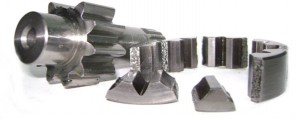
Commissioning of a hydraulic system is a step that, if done without certain precautions, can spell trouble.
Most basic cares are well known, like, for example, making sure that there's oil in the tank, the pump case is filled with oil, the suction valve is open, etc. But there's one peculiar start-up scenario (which I have personally witnessed quite a few times) which, if not acknowledged, can reduce a hydraulic pump's life or even kill it altogether without any apparent reason.
In this post, I want to describe two of such incidents that involved completely different pieces of equipment and, in both cases, came close to suffering a pump failure during the start-up, and then discuss their "common denominators."
Case 1 (from 2015)
A large industrial HPU with 500 kW of electric power installed, two electric motors driving four pumps each (two variable displacement piston, plus two internal-gear), plus a smaller motor with a single variable displacement pump. Five thousand liters of oil with at least a meter of head above the suction ports - just the way I like it! A beauty to behold!
I'll go straight to the "almost failure" now. The OEM tech (I don't think I should mention the brand of the HPU, let me just say that it's well-known and rhymes with "Shmexroth") started the system and began his usual checks. Now, I have a golden rule to never intervene in somebody else's work (just as I don't like when someone does this to me), but this time, I was lucky to notice that one of the pressure gauges wasn't showing the correct pressure and stop the unit in time.
I had a chance to study the hydraulic diagram, and I knew that the smaller gear pumps on each of the big motors were feeding a constant pressure gallery with the relief valve set to 150 bar, with both pumps sending oil to the same place through check valves. The gallery was supplying pilot pressure to four A4VSG closed-loop pumps. This same gallery was also connected (again via a check valve) to a different pressure source set at 95 bar and fed by the variable displacement pump of the smaller motor.
The logic behind this connection was to start the small motor first, pressurizing the pilot circuit to 95 bar, which would allow the displacement controls to null the closed-loop pumps before starting the big motors.
When the main motors started, however, the pilot pressure gauge was still reading only 95 bar. Fifteen seconds passed... Thirty seconds... Am I the only one seeing this? I rushed to the HPU and started putting my hands on hydraulic pumps - cold, cold, cold, oh sh*t, this one's hot! So I hollered to stop everything - and, luckily, was heard.
It turned out that both gear pumps were running dry. No oil had reached them - even with the positive 1-meter-plus oil head and ample suction lines! We bled the suction lines, and the pressure immediately jumped to 150, and both of the gear pumps were cold now.
Case 2 (from last week)
I overhauled the main pump from a telehandler the other day - a tandem composed of a closed-loop A4VG for the drive and a gear pump for the boom, and the client asked to assist with the start-up. No problem!
The unit had been mounted on the machine by the client's crew. The tank was cleaned, the oil and filters were replaced, and everything was connected. We started the machine, and the charge pressure in the closed-loop transmission was normal, but there was no boom movement! Again - I yelled to "stop everything" and face-palmed myself for not checking what I'd seen so many times before! Same old picture - a positive oil head, a short and wide suction hose, a tank full of oil - and the gear pump is running dry! I bled the circuit, this time by loosening the fitting at the pump's outlet, and the open loop began to function immediately.
Now - let us consider what it is that both of these cases have in common:
1) Both of the systems had empty tanks that had been drained and re-filled with oil before the start-up.
2) Both of the suction lines had an arching bend that allowed the formation of an air pocket.
3) Both of the systems had the outlets of the pumps "closed" - meaning that substantial positive pressure had to develop in the pressure line for the oil to flow. The first one had the 95 bar gallery, and the second one had a steering priority flow divider mounted directly at the gear pump outlet.
When a gear pump (or a piston pump, or any other pump for that matter) can pump oil freely to the tank (through the central gallery of an open-center directional control valve, for example) - it can easily create enough vacuum in its inlet to "suck out" the air pockets and expel them to tank, especially in case of a positive oil head.
But when there's a "blockage" at the pump's outlet, which requires certain pressure to operate (like the priority valve compensator bias spring, or a pressurized gallery, or even a check valve) - if the pump has an air pocket in its inlet - it won't be able to "pump it out" or create enough pressure with air alone to "open" the blockage. In this case, the pump will run dry either until you notice that something is "not right" or until it grinds itself out of existence.
So, when you are re-commissioning a hydraulic system that has the oil tank that's been drained and re-filled, has suction lines that can trap air pockets, and has a "blocking element" at the pump's outlet - don't rely on the positive oil head alone and make sure you bleed the circuit. In most cases, all you need to do is loosen a fitting in the pressure line and let the air out. As an alternative - at least make sure that you monitor the pressure during the start-up and have means to stop the prime mover if you detect that the circuit is running dry.
P.S.
By the way - the same can also happen to submerged gear pumps you often find in HPUs that have a pump hanging from the bell housing mounted on the tank cover. People find it unbelievable that a completely submerged pump can run dry - but it can happen!
Just being aware of this phenomenon makes you a better tech already!