
Insane Hydraulics
Bold and audacious blog about fluid power
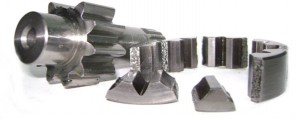
My recent posts about Hagglunds CA radial motors and the disassembly of cartridge valves made me recall a peculiar incident that happened to me a while ago and taught me a lesson that not everything that looks like a cartridge valve is, in fact, a cartridge valve. Well... in my particular case, not taught, for I kind of knew it already, but rather ratified, but in any case - it is an interesting fact, it has to do with hydraulics, and for me, this translates into "it goes in the blog".
So - the myth, or a "trap," if you will, is that whenever you see a round body with a hex and an adjusting screw, screwed into a manifold (or a pump/motor endplate) - you naturally assume that it is a cartridge valve that will come out as a single-piece assembly because this is what cartridge valves are supposed to "do". Here's a nice example - the Hagglunds COCB dual cross-over relief valve manifold - these valves look like "normal" cartridge valves, don't they?:


In 99% of cases, this assumption would be correct and lead to the legitimate and battle-proven chain of events:
But in that one "deviant" percent of cases, the traditional chain of events can transform into:
Allow me to illustrate with the COCB manifold:


As you can see - while this valve looks like a normal cartridge valve from the outside - it is actually composed of several parts that are stacked but not joined together, and when you unscrew the external body - several small (but very important) pieces become loose, and can easily fall out of the cavity if the valve is installed in a position that makes it possible.
I still remember how genuinely surprised I was when I unscrewed one of these valves while standing on a four-meter ladder leaning against a lifted raise-boring rig, and the first thought that ran through my mind was: "Boy, am I lucky this valve is not mounted sideways!", because had it been mounted sideways (or, God forbid, facing down) - I would be either "fishing for parts" in a mud puddle, or preparing myself for a tough conversation with the client about how his expensive operation would need to pause indefinitely because of a tiny poppet that had just fallen down the 300-meter deep pilot hole. I imagine my opening statement would be: "Tell me, can a person really be held accountable for the fact that gravity causes things to fall down? I don't think so!.." (Note to self: "Buy a book on having difficult conversations and carry it in your service vehicle").
Awareness is the key. Awareness and preparation. Always bear in mind that what looks like a single-piece cartridge valve from the outside can be a stack of loose parts under a screw-in cover, if possible - get a "part-catching" container under the "intervention area" - and you will reduce the risk of fishing for lost parts in mud puddles to a minimum!
P.S.
Final tip of the day - the COCB relief valve disassembly. The spring and the poppet fall out easily, but the seat sleeve can be pretty hard to pull out because of the seals. Here's one way of doing it:

