
Insane Hydraulics
Bold and audacious blog about fluid power
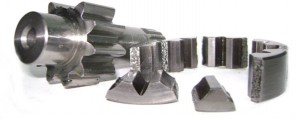
Cartridge valves are not supposed to be dissembled, and yet it is something that needs to be done quite often. Why? For about a thousand reasons that can all be summed up as "attempting to make it work." For cleaning, unsticking stuck spools, getting to obstructed orifices, replacing hidden seals, adding seals to unsealed versions, adding/removing pilot ports, removing/replacing bias springs, etc.
Here's a concrete example - this 2/2 normally-closed atmospherically-referenced pilot-operated cartridge directional valve from Hydraforce was causing a malfunction because it needed to stay closed with pilot input of 6 bar or less, and yet - I am testing it with 5.5 bar, and it is completely open:


It's also obvious why this is happening. The reference reads PD10-34-0-N-40, the number 40 stands for the psi of the bias spring, which means the spool is fully shifted at a mere 2.8 bar. In this particular case, I could either try sourcing the correct model - something that would probably take me several days, or I could solve the problem "on the spot" by replacing the bias spring with a stronger one or, as an alternative, by removing the atmospheric reference (welding the vent hole shut) and opening a threaded port on top of the cartridge and then referencing it to a higher pressure. Whichever solution I might choose, I would still need to disassemble the cartridge without damaging it.
If you look at the section view, you'll see that this cartridge valve is of threaded design - the hardened sleeve has a thread at the end, and it is tightly screwed into the body that houses the spring. This construction is pretty common, and since cartridge valves are not supposed to be serviceable - the sleeves, naturally, don't possess any "classic" means of connecting to a spanner in order to apply the torque necessary to undo the threaded joint (often enhanced with thread-locking glue). So, what would be the best way to solve this puzzle without harming the delicate precision-honed spool/sleeve assembly?
Clamp the sleeve in a vice with soft jaws? Use a pin punch or a drill bit in one of the holes to turn it? Grab it with a pair of pliers? Grab it with two pairs of pliers? Maybe secure it in a lathe chuck with a layer of sandpaper to "soften the bite?" Any of the above methods might work, but they all carry the risk of rendering the valve inoperable either due to deformation of the sleeve or damage to the honed surface from the object wedged in one of the holes. In this post, I want to showcase a simple DIY tool that reduces the risk of damaging a cartridge valve during disassembly to a minimum.
The idea is still to grip the sleeve by one of the holes, but instead of doing it via the intuitive but destructive "pin-punch-in-the-hole" way, we will do it in a "more guided" fashion. Let me show you what I mean by that.
The first thing that you need to do is look at the cartridge valve that you will be disassembling (ideally - at its section view, if you can find it) and decide which ring of the holes in the sleeve would be the safest to "grab". For the valve that I just showed you, the safest zone would be the one at the nose end of the sleeve because the valve would remain operational even if our tool deformed or nicked one of the holes.
The next thing to do is measure the diameter and width of the sleeve in this "safe" area:


In this case, the diameter is about 14.7 mm, and the width is 9 mm. Then, you need to find two straight pieces of steel approximately the width of the "safe area". Luckily, we've got lots of scrap in the shop, so I quickly found a 9-mm wide sliver from a random steel plate and cut it in half to make the two pieces:


Now all you need to do is join the two pieces together, and drill two holes through the seam - one the diameter of the sleeve, and the other the diameter of the sleeve holes, at 90º to the first one, like so:


The idea is to end up with two halves that can tightly fit around the sleeve without over-compressing it and secure the drill bit aligned with one of the holes so that when the torque is applied, the bit has no chance of tilting and denting the hole:


A very important note - the diameter of the big hole must be equal or slightly bigger than the diameter that it will be gripping, otherwise it will deform the sleeve! Now you can use this tool to secure the nose of the cartridge in a vice and "torque at will":


As you can see - I easily managed to undo the thread, and I didn't even require applying any heat to soften the glue!
I think that spending half an hour to make a tool that reduces the risk of scrapping a client's cartridge to a minimum is not a waste of time, even if you use it only once. So - there you have it - a simple DIY tool for disassembling cartridge valves of threaded design:


