
Insane Hydraulics
Bold and audacious blog about fluid power
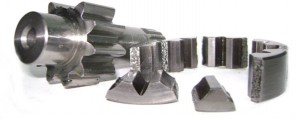
As soon as I made a post on how I waited for a long time for an H1B hydraulic motor with a hydraulic proportional displacement control to appear in our shop - it started to "rain" H1B motors! I kid you not. This week, I got two more specimens of exactly the same "species" - the H1B160 - completely destroyed by overspeed from the backlash of a stuck drilling string (something that I had definitely seen before).


Total and spectacular damage aside, there's an interesting thing related to this failure I would like to talk about - the tipping of the valve segment in bent-axis hydraulic motors and the distinct marks that the sharp edge of the segment leaves on the surface of the end plate when it happens.


These "samples" are perfect for that because they come from the same drilling rig (both failures actually happened during the same shift), and while one of the motors has several thousand hours on it, the other one is brand new - with literally minutes "on the clock." And yes - it's the one that got the rotary group mashed into bits and pieces. The fact that this motor is brand new means that all of the segment tipping marks on the surface of the end plate appeared during its first (at last) minutes of life.
Load-induced overspeed happens when a load overruns what safety or speed-controlling systems a circuit may have and releases its energy in an uncontrolled fashion, causing the hydraulic motor to rotate well above its maximum allowed speed. Think - a hoist dropping a heavy load when a negative brake fails, or an elastic several-hundred-meters-long drill string stuck at its end working as a perfect torsional spring that can be "wound" multiple turns to the maximum torque the hydraulic motor plus the reducing gear box can supply - releasing all this energy in a single "z-z-z-z-z-z!"
The biggest "catch" of this type of failure is the fact that it can happen even with the systems that are supposed to keep the speed of the motor under control in place - i.e. over-center valves, or, as is often the case with core drilling rigs, motor-mounted manifolds with uni-directional restrictors, that throttle the outlet flow when the motor is rotating in reverse. All of these systems rely on hydro-static braking, which essentially means they need oil to operate - but when the oil is "squeezed out" through the internal leakage of the motor's rotary group or "thins out" due to cavitation - the motor, driven by the runaway load, becomes a loose cannon. Even worse, actually - it becomes a loose cannon without hydro-static balancing of the cylinder block - in other words, an intricately-linked poorly-lubricated mechanical contraption forced to spin at thousands of rpm.
So, if we look at the sealing surfaces of the end plates, we'll see several parallel grooves, left by the edges of the segment valves. Most of the marks are located on the min-displacement side, which means that the segments were tipping towards it - i.e. - lifting the end facing the max. displacement side.


In my head, this can be explained by the fact that when the motor was over-revved by the load - the barrel lost hydro-static loading, and the centrifugal force from the piston heads acting on the barrel walls was enough to overcome the mechanical pre-load of the rotary group and tip the assembly away from the endplate surface, like so (do not forget that in these motors the barrel and the segment vavle are linked by the needle bearing iniside the barrel, which makes them a single "tippable" assembly):

There are multiple marks, which means that at least several "z-z-z-z-z" moments happened before the motor exploded. This is something that I can explain and understand. But... there are also several edge marks on the other side. This picture is from the brand-new motor:

Note that these are distinct segment tipping marks - they are not the segment end-of-travel mark that all variable displacement bent-axis motors develop over time.
And this is something that I, honestly, can't find a reasonable explanation for. My current theory is that these groves were left by the segment valve falling back on the end plate after tipping. But I am not 100% sure. Some time ago, I stumbled into a technical file (from Sauer Danfoss, if I am not mistaken) devoted to this phenomenon - and I thought I stored it somewhere for "later study" - but I, for the love of me, can not find it!
So - here's a request for the audience. If any of my readers have the file (or a better explanation for the tipping of the valve plate towards the max displacement side of the end plate) - I would appreciate it if you could share it so that we could all learn something!