
Insane Hydraulics
Bold and audacious blog about fluid power
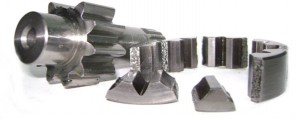
In this episode of "Insane Inventions," I want to show you my experiment with this lovely pair of Beka-Max grease pump elements - leftovers from an old lubrication project:


As you can see, one of the elements has a piston with a missing head - the result of an incorrect mounting procedure (these elements should be inserted at an angle so that the head of the piston can fit into the groove of the eccentric ring, and if you don't do this - they get... a headache). The other one looks okay, but it has a damaged check valve.
Even though these pump elements are not functional, I could never throw them away because of the impeccable precision-ground hardened piston/sleeve pairs. I always thought that someday I would find a use for them - perhaps DIY a lever-operated pump or a dead-weight pressure tester.
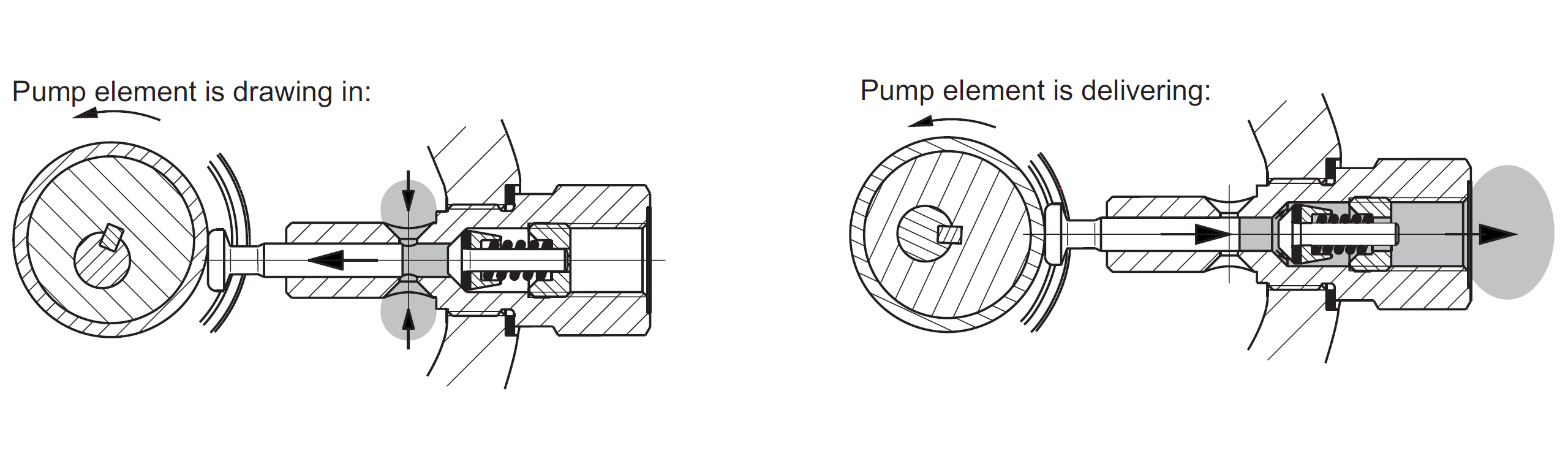
These pump elements are super simple - they only have one single check valve at the outlet, and their suction phase relies on the pumped medium filling the vacuum pocket behind the retracting piston through the side holes in the sleeve:
I wanted to find answers to the following questions:
Before I get to my experiment, I want to say a few words about screw-based pressure systems. A screw-based pump is essentially a piston pushed by a screw - just like the one I used in the Pressure Maker II. After using it for a while, I have a piece of advice for anyone building a similar device: "the more displacement you can give your screw pump, the better!"
As it turns out, pressure sensors, gauges, and their respective oil-conducting elements (read - capillary test hoses) consume a certain volume of oil under pressure due to their inherent elasticity, the compressibility of the fluid itself, and inevitable air pockets. So, when you have several gauges connected in parallel, you may discover that your piston's displacement isn't enough to reach the target pressure. Moral of the story - give that piston of yours the maximum possible travel!
You might think a classic lever-operated pump would solve the limited displacement problem - and you'd be right, but a screw pump can do one thing a hand pump can't - it can wind the pressure down just as easily as it can wind it up, and in certain tests (like, for example, verifying a pressure switch's reset point) this ability is crucial. An ideal "Pressure Maker" should probably contain both a screw pump and a lever pump, or perhaps be modular to allow for adding a screw-pump element when required.
So, let's see if these pump elements can be turned into something useful, shall we?
I decided to use the headless piston for this experiment. The plan is:
Easy-peasy. Here is the new piston head - it's just a hard steel washer that I welded on top of the "stump":

I had some 608Z bearings lying around - old guide bearings from our bandsaw. (I guess you can see the pattern now - I can't force myself to scrap anything for which my brain envisions an alternative use.) I decided to use them for the lever that will be pushing the piston. As usual, every single part was made from bits found in the scrap bin:


And I used a cut of random rectangular profile to secure the pump element and also serve as the oil tank, like so:

And finally, I added a lever and the return spring:


This contraption is crude, but it allows me to check the pumping action and determine if this project has legs, and, by the looks of it, it totally does:

What a beauty! Based on what I learned from the current setup, I can confirm that:
You can also see the grease relief valve mounted on the T-junction with a bolt sticking out. I'm using it to jam the ball to see if the relief can be converted into a makeshift tank bypass valve, and since I saw no leakage, it absolutely can! I have this beautiful vintage aluminum handwheel from an old German valve, and I can already envision how good it will look on this bypass actuator.
Okay then, my friends, now we know that these ubiquitous grease pump elements can be much more than they seem. Stay tuned for the updated version of this pumping contraption and - I suppose - eventually - the DIY dead-weight tester.