
Insane Hydraulics
Bold and audacious blog about fluid power
For a long time, the dynamic load sensing remained an obscure topic to me. I could recognize that dynamic load sensing systems were... well... more dynamic than their static counterparts, but if you asked me for any details - you wouldn't be getting a meaningful answer. In this article, I invite you to a thought experiment that I like to use to conceptualize the principles of dynamic load sensing, and I honestly hope that my crude analogies make sense.
You probably noticed that I count orifices in the title - "One Orifice, Two Orifices, There Orifices..." - there's a reason for that - in our imagined scenario, we will, indeed, be adding orifices one at a time, but before we get to the orifices, we need to start with

The Simulator will represent our load-sensing steering valve (or a directional valve) simplified to the maximum. It is stripped of all the directional functionality and is left with just the variable orifice and the 3/2 directional valve for connecting the LS port to the load. Imagine it as a panel with two levers connected to an imaginary load of your preference (a relief valve or a vertical single-acting cylinder with a weight on top).
In an actual real-life valve, the LS-distributing part is always incorporated in the directional (be it the linear spool of a DCV or the rotary spool of an orbital steering valve), but in our Simulator these functions are separate - and this is a good thing because it allows us to reproduce different timings of the LS connection - orifice before LS, LS before orifice, orifice + LS at the same time. Such under/over-lapping transitions are hard-engineered into the actual spools, and designers spend a lot of time optimizing them. Our imaginary two-lever testing apparatus, on the other hand, gives us the luxury of choosing how we want our valve to behave in that regard.
Now that we have our "flow consumer" fired up and ready to go, let us devise our "flow supplier" (this is the moment when we begin counting orifices), starting with

As you can see - this is the good old three-way pressure compensator (a.k.a priority valve) built to match the pressure in the CF port to the pressure in the LS port plus the pressure of the bias-spring, and as promised - it has exactly one orifice - the damping orifice in the pilot pressure line. When you connect it to the Simulator, you get the classic static load-sensing arrangement which keeps the flow across the variable-orifice constant (even when the load-induced pressure varies) and dumps the excess flow into the EF port. Simple, right?:

So, we are sitting in a room with our Simulator panel, and the priority valve is placed in the room right next to ours. We pull the levers back and forth, confirm the constant flow under variable load, and everything is working just fine... oh wait - we forgot about one very important thing! When we use a relief valve for our load - everything is fine and dandy, but when we use a single-acting cylinder with a heavy weight for the same purpose - we notice that the load drops a little before going up - which, of course, means that we forgot about the load drop check valve. How silly of us! So let us correct this real quick, shall we?

Now we are cooking! So where was I? Oh yes - we pull the levers back and forth, register the constant flow under variable load, and everything is working just fine until our landlord decides that we need to move to a room down the hall, and now we are some ten meters away from our flow supplier. No biggie, right?
Wrong! Because now our system has become slower to respond. It still manages to keep the flow constant, but when we need to start from a standstill - there's a "hard spot" now. Of course, the longer lines that we just installed are the culprit, and the time it takes for the spool to shift and throttle the EF outlet and then the pressures to rise in the long elastic lines has become noticeable to the point of compromising "our operation."
The landlord won't let us move back to the old room, and there's nothing we can do about the length of our hoses, so we need to come up with a way of "assisting" our compensator and somehow make it respond faster to our distant signaling. To achieve this, we increase our orifice count to
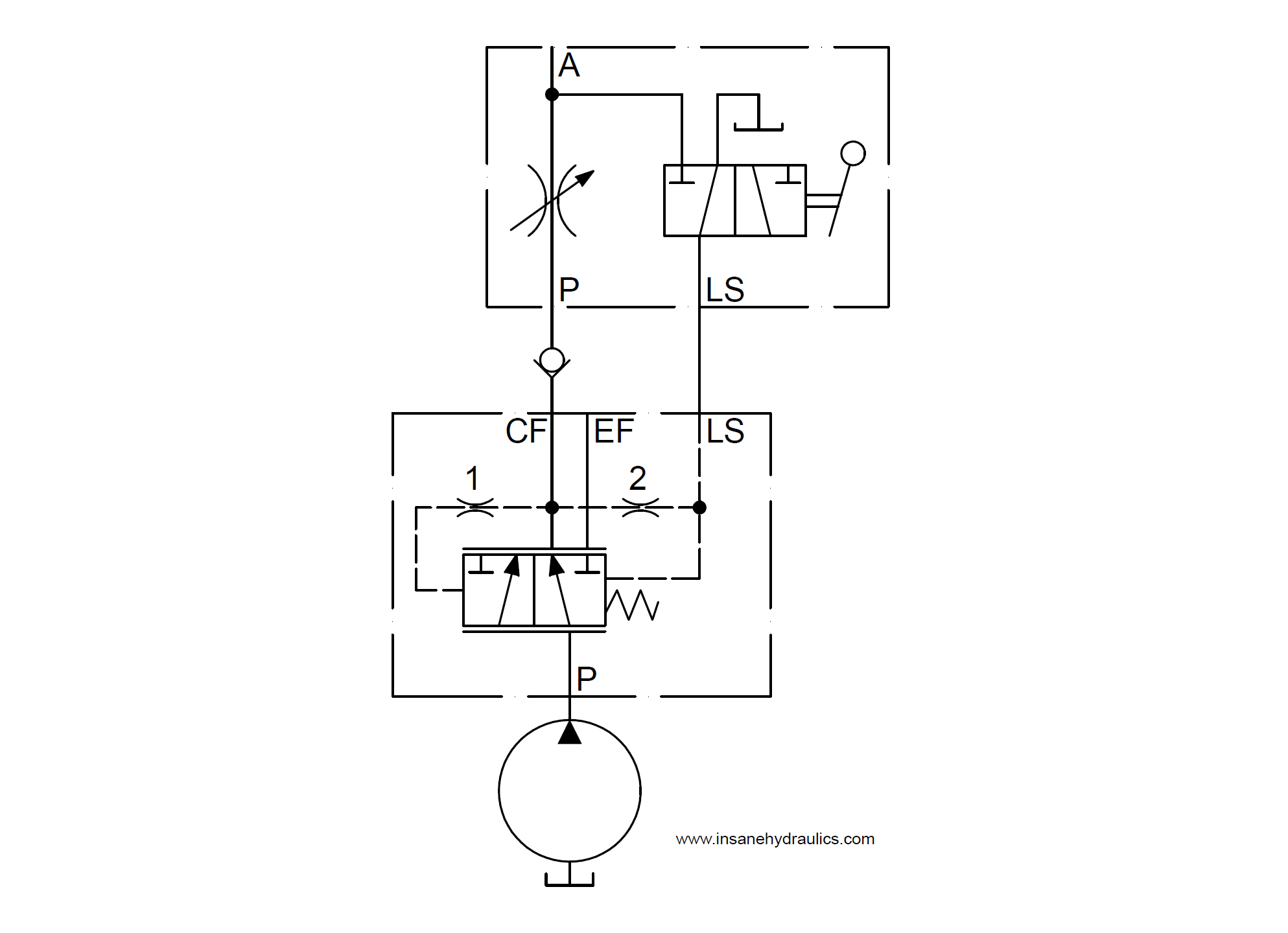
That's right - there's a tiny flow in our load sensing line due to the orifice Nº2, and if we look at how our system behaves after adding this dynamic orifice - we'll see that even though the pressure-matching spool of the compensator still does what it was doing before - i.e. matching the pressure in the CF port to the pressure in the LS port plus the bias spring pressure - we can "make it go" faster. First of all, its stand-by position is shifted from what it used to be because it has to keep the small flow through the dynamic orifice - in other words - it is "crouched on the starting blocks" instead of simply standing there "waiting for the starting shot." And then - since we are in full control of how we time our LS-shifting part - we can even go a bit further and connect the LS line (and rise the pressure in the CF port) a fraction of a second before opening the variable orifice. Pretty cool if you think about it - our load is now supplied in parallel both through the main line (via the variable orifice) and the LS line!
On a side note - there's a hidden benefit in the constant flow of the dynamic LS line - it circulates oil through the valve, and if it were to stand by for prolonged periods in cold conditions (like an exposed steering column) - this flow would keep it warm and prevent it from seizing due to thermal shock.
Oh, wait... When we use the vertical weighted cylinder as our load - it drops again momentarily. I guess we should add a load-drop check valve to the LS line, too:

Great! The test load is not falling now (read - the steering wheel is not kicking back). Everything is working as it should, but when we measure the outlet flow, we see that something is not adding up - we should be getting more flow. Oh - it's the damned long lines again - the pressure drop of the long hose adds to the drop of the variable orifice and is a flow-limiting factor now because the bias spring is kind of weak! I wonder if there is something we can do about it without upgrading the spring?.. How do you add bias to a spool in hydraulics? With pressure, of course. Which means it's time for - you guessed it -

Oh - I see what you did there! You inserted an orifice in a line with constant flow, and now you are using the pressure drop induced by it to assist the bias spring and increase the bias pressure. How very clever! This actually means that one can fine-tune the response of such a system by changing the size of this orifice. Make it smaller - and the response becomes more aggressive.
But there's something else we could do with such a valve. You actually don't need to connect the LS line to the load to control the pressure in the CF port. You can totally use another variable orifice (or a relief valve) to throttle the flow in the LS line (I don't think it can be called a load sensing line because it is not sensing the load anymore, but I am keeping the name anyway) and remotely control the pressure for an even faster (albeit less efficient) control. Almost like a remotely piloted relief valve of sorts:

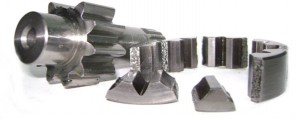
And this, my friends, is where I leave you be, in hopes that this experiment has left you with enough "food for thought" and that a cutaway view like the one below is no longer met with the phrase "What the hell were they thinking putting all those orifices in series?.."

P.S.
Steering product catalogs often state that a static LS steering vale must be used with a static priority valve and a dynamic LS steering valve must be used with a dynamic priority valve. After having read all of the above - tell me - would a static LS steering valve work with a dynamic priority valve? And what about the other way around?