
Insane Hydraulics
Bold and audacious blog about fluid power
Virtually all hydraulic shops deal with charging hydro-pneumatic accumulators with nitrogen, and if you work in one, you already know that along with requests for charging "accumulator-accumulators " come requests for charging anything else that requires compressed nitrogen at a certain pressure to work properly - things like hydraulic breakers, gas springs, special actuators, etc...
Dealing with standard industrial stuff is easy - all you need is a charging kit compatible with what you stock/sell the most, a couple of adapters for different stem threads, and you are pretty much all set.

But dealing with proprietary stuff is a whole new ball game because OEMs like to invent "peculiar" charging port configurations, and thus when a client brings his very special hydraulic breaker to a business that is renowned for charging "normal" hydro-pneumatic accumulators, there's no guarantee that they will have the right accessory for charging it.
In that case, there are three ways to address this problem:
First - you can politely refuse the charging request under the pretext of not having the right tool for the job.
Second - you can suggest deferring the service while you "hunt" for the necessary accessory (and I must say that with the likes of Ali Express, Amazon, eBay, etc... it is way easier these days than it used to be back in the day).
And third - you can come up with your own charging accessory, using what you have got in the shop.
Since I like making stuff, I, hands down, prefer the third approach, and today I want to share with you a super simple way of making a nitrogen charging accessory for "valve-in-hole" charging ports, which are, essentially, threaded holes with a centered poppet valve that must be pressed in to open the gas passage.
Arguably, you can still fill such accumulators with just a fitting with the right thread because the poppets do work as check valves, which means the gas pressure will open them - but this is cumbersome at best because there's no easy (and safe) way for you to accurately check the charging pressure and vent it if needed.
A "proper" charging tool will have a way of threading into the port, pressing and depressing the poppet at will, connecting the tool chamber to your nitrogen bottle and a pressure gauge, and venting the pressure from the chamber to the atmosphere. And if you are an engineer, you probably imagine the "classic" construction for such an accessory - something along the lines of a threaded spool with a high-pressure seal for pressing on the poppet and a separate needle valve for venting the chamber, and this construction is absolutely fine - only - it's not that DIY-friendly in the sense that you can't make it without machining equipment, and even if you have it - it will definitely take some time. Luckily there's a simpler way. Here's a part that you can find in any hydraulic shop, and that can single-handedly replace both the sealed spool that moves in and out and the venting valve:

That's right. A random adjusting screw (a long set screw) with a seal nut, when put in a threaded hole, can be a throttled vent to the atmosphere when the seal nut is not tightened and can work as a surprisingly well-sealed poppet-pusher when the nut is (slightly) tightened. But I wouldn't be me if I didn't show you a concrete example.


This is a pneumatic spring from a core-drilling rig rod holder. It is, essentially, a double-acting cylinder with the blind end filled with compressed nitrogen. The charging port is a 1/8'' BSPP threaded hole with a tiny Schrader valve in the bottom. I need to check the nitrogen pressure, I don't have the charging fitting, and I am short on time...
No problem! Since I am inside a hydraulic shop, I have all sorts of fittings around, so here's all that is needed to make the DIY nitrogen-charging solution:

Here you have a 1/8'' x 1/8'' male-female fitting for getting into the borehole, a 1/4'' BSP T with a Minimess socket (the socket is actually damaged, and I will replace it, but the T is still good), a 1/8" to 1/4'' adapter, some U-sits, and an old Allen key for the push rod. Note that the type of the fittings does not matter at all - I could just as easily have used JIC or metric fittings - the only thread that does need matching is the charging port thread - the rest can be whatever you have at hand.
Now all I need to do is flatten the male end of the T-fitting and drill and tap it for the thread of my adjusting screw (M8), like so (I made the threaded hole about 20 mm deep, and the whole process took me less than 15 minutes):

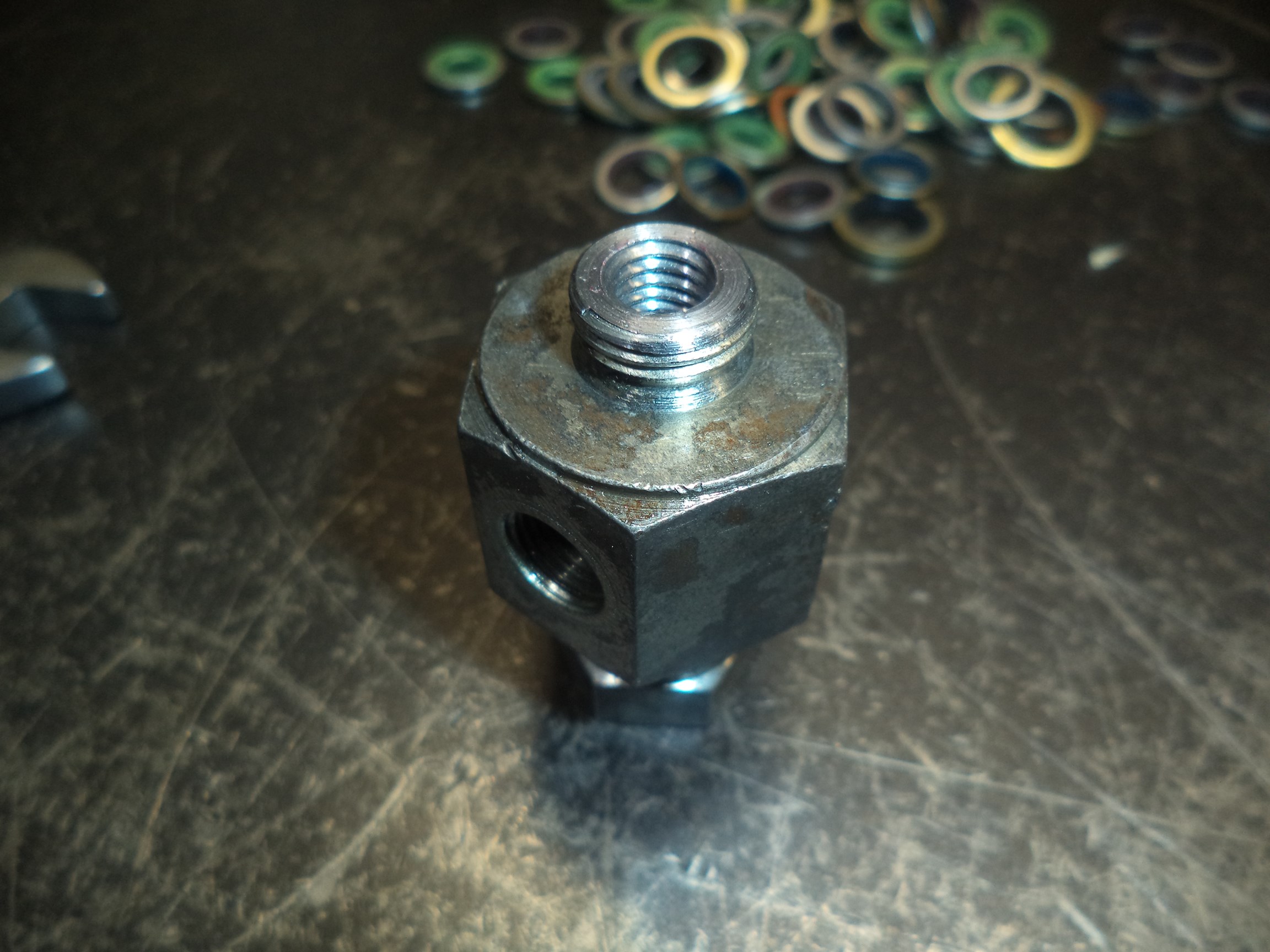

The final step would be to assemble this contraption, take an Allen key of the size that fits into the fitting hole, and then cut it down to the required length. Yes - you are right - the Allen key from the photo with supplies was too short - I had to use a different one.


And now for the demonstration. First I thread and tighten the "leading" fitting into the charging hole:

Then I attach the T - note that the swivel end of the T allows me to position it at a convenient angle:

And now I can easily check the pressure of the nitrogen gas spring:


It may seem that working the seal nut may be cumbersome - but it's actually not! You really have to try it for yourself to see how easy it is - all you need is to work both the seal nut and the set screw at the same time - you touch the base with the seal nut and screw in the set screw, and when the gas connection is open and you hear the hissing, all you need to do is tighten the nut by about half a turn to seal it - that's it. And if you need to vent some of the pressure you just undo the nut and the gas is safely vented through the threads. Just make sure the thread is long when you cut it so that you accidentally don't unwind the set screw all the way out and get a "surprise of your life" when the Allen key bit is shot out of your tool like a bullet!
And of course, you can use the same Minimess socket for charging. I have an extra T with multiple Minimess connectors that allow me to charge and monitor the pressure at the same time, but you can obviously find a different solution for that - for example, thread another hole in the T fitting for a second Minimess.
I am "selling" two ideas here - one is using a long set screw and a seal nut commonly used in hydraulic controls as a sealable poppet-pusher/venting valve, and two - using a hex Allen key for the push rod - the rest can be totally random.
Note that this accessory is also upgradable. If I had to charge an accumulator with, say, a 1/4'' BSP valve-in-hole port - I would just need to replace the front fitting, and cut another Allen key to the required size - and that's it!
This solution is obviously not suited for extremely high pressures, but then I can't remember the last time I was required to charge an accumulator to a pressure above 100 bar, so I would say that it's good for most everyday over-the-counter cases.
Warning! This tip is targeted at professionals who know what they are doing. If you have never worked with hydro-pneumatic accumulators and don't know what they are and how they work - do yourself a favor - forget everything you just read!