
Insane Hydraulics
Bold and audacious blog about fluid power
If I were to name a single piece of machining equipment I can't live without, it would be our lathe (Knuth Compass 250/1500, 1998 model):

We stopped accepting machining jobs a long time ago (there was a brief period when I single-handedly manufactured cylinders with the help of this bad boy - and, in retrospect, what a waste of time it was) but this machine comes in handy every single day, and I always say that every hydraulic shop must have one.
When you enhance a lathe with attachments and clever upgrades, you can use it for much more than turning. In this post, I want to show you my latest DIY lathe upgrade - degree markings on the chuck, which are super convenient for a number of "obvious machining reasons."
Now, there is no novelty in the upgrade itself - degree wheels have existed since the dawn of time - but what I want to showcase today is a way to divide a single rotation of a chuck into exactly 360 degrees, using the gearbox of the lathe as a makeshift indexing head.
Here are the "before" and "after" pics, just to give you an idea of what we will be crafting today:
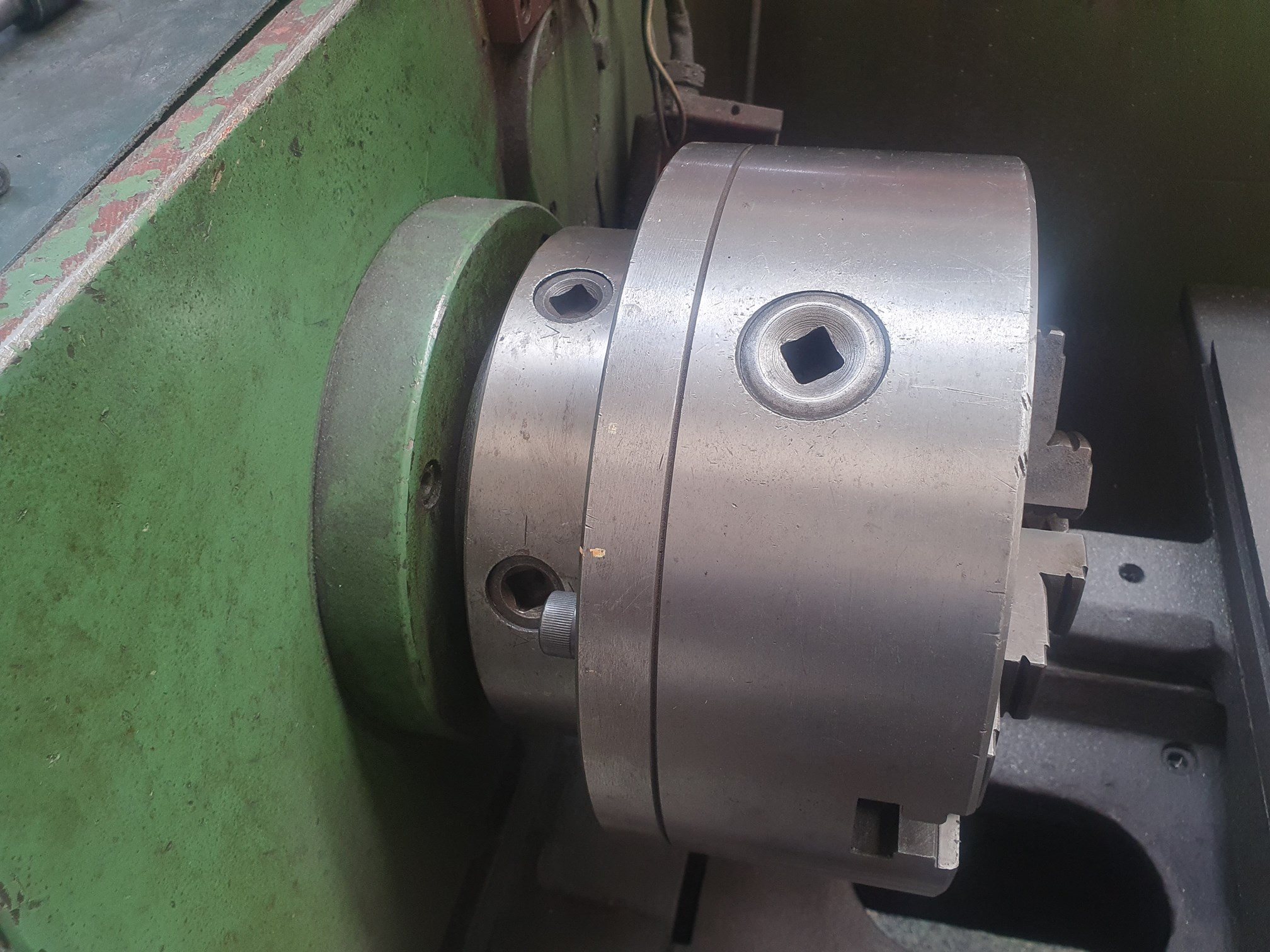


The method that I am about to describe worked surprisingly well, and the attachments I built to "make it happen" - the hand-crank and the spindle brake - will also be very useful in the future (for marking, milling, drilling, etc.).
The marking part is simple - you use the compound slide (or the carriage) movement to cut shallow linear grooves on the surface of your work (in our case, the chuck itself) with a suitable tool, and pull every fifth or tenth groove a couple of millimeters further to distinguish them:

The tricky bit is making sure that every groove corresponds exactly to one degree, and to achieve that precision, we need:
Let us start with examining the spindle drive. In this particular case, the gearbox is controlled by two levers - one with three positions, and the other with five, providing a total of 3 x 5 = 15 speeds:

Here you can see the belt-driven input shaft, and the insides of the gearbox:


I wish the picture could transmit the smell - the oil in the gearbox smelled exactly like that old, dented oil can my father had in his garage. Boy, did taking that lid off flood my mind with childhood memories!
Since I was looking for total precision, I needed to know the exact ratios for every speed in the gearbox (to pick the "best one"). The only way to get them was to painstakingly count the teeth of all these gears. In the old days, after getting the counts, one would need to do the necessary math "by hand," but in this day and age, all you need is an AI prompt. I explained "the situation" to Gemini and asked it to kindly make a table with the gear ratios for me, which it did in about a second.
You can check out the table (and if you inspect the source, the respective JavaScript file) here. No matter how you look at it, this tech is amazing. It would probably take me a good half hour to hack such a script together, so in this case, the AI is an absolute time saver.
I was hoping that at least one of the gear ratios would be a whole number (ideally 40:1 - the ratio of most dividing heads), but alas, none of them were. So, I picked the "winner": the 43.2337164750957825277 : 1 ratio combination, which corresponded to the lowest speed of the gearbox.
But before I show you my (state-of-the-art) DIY indexing solution, let me first show you the "mechanics" - the crank and the spindle brake (made from scrap, as usual):


The attachments may look... provisional, but I assure you that they are indestructible.
Now, the last thing I needed was a way to reliably index the turns of the input shaft. Here is how I went about it - given the input - a 43.2337...º turn of the input shaft for a single degree turn of the output shaft (or a 432.337...º turn for ten degrees) - I made the following drawing with nanoCAD (very capable free version):

Such a drawing is actually very easy to make in a 2D CAD program - all you need to do is rotate and copy a line by a given number of degrees. The outer wheel corresponds to 10-degree increments, and the inner wheel (which will be separated from the outer wheel) corresponds to single-degree increments.
Then, I 3D-printed the two indexing plates that would snap onto the input shaft pulley with tiny magnets:


I also pressed a small 2 mm pin in the face of the pulley to fix the position of the outer plate:

While the outer plate is fixed, the inner plate (0 - 10º division) can rotate freely (every 10 degrees it is rotated into a new starting position).
Then, I printed the drawing on a sheet of A4 paper, laminated it, carefully cut the dials out and glued them onto the plates with double-sided tape:


And this is what the "finished product" looks like:

By the way, the transparent cursor piece is made from a chocolate box cover. The premium ones are best for this because they use thicker acrylic. How is that for an excuse to treat oneself to a nice box of premium chocolates?!


The indexing process is simple: you start by placing the zero of the small dial next to the zero of the large (fixed) one and scrape the first ten marks using the ten divisions of the smaller dial. Then, you rotate the zero of the small dial to the 10-degree mark of the large dial and repeat the process. I also used the brake to create constant tension to remove any gear backlash, tightening it up a bit further for every actual cut.
So, the big question is: is this "technique" precise? Well, see for yourself. This is where the 359th cut fell (I marked the first cut with the orange dot):

I think this can be categorized as pretty damn precise! Here is how nice the dial marks look after deburring with sandpaper:


So, there you have it - with a little bit of ingenuity, a lathe can become a makeshift indexing head with respectable precision!