
Insane Hydraulics
Bold and audacious blog about fluid power
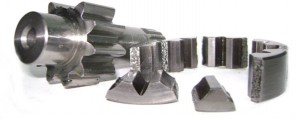
So, you are a hydraulic tech and you got yourself a Rexroth A6VM variable displacement motor for a major overhaul, something that you've already done hundreds (if not thousands) of times. Since you hold yourself to the highest of standards, you meticulously follow all the procedures required to deliver top-notch service, and once you get to the motor shaft (which will be reused because it is still in good shape), you decide that the threaded holes for the retainer plate bolts need to be cleaned of the remains of the old thread-locking compound. Then you get your best taps and ve-e-ery carefully do one hole after another, fully aware that these threads have tight tolerances, and if you rush it, you will end up with a piece of a very hard tap stuck in a blind hole in a super-expensive part. Naturally, you don't want that. First hole, second, third... the unlucky thirteen... going well so far... hole fourteen... you're already humming (or whistling) Monty Python's "Always Look on the Bright Side of Life" because the scary part is almost over, and... snap!:


I can feel your pain, brother! And please don't stop the humming - this song is perfect for this moment, because I am about to show you a simple hack that will save your "rear" now and, quite possibly, on future occasions as well. Broken-off taps happen to everyone who works with taps. And no, we won't be milling anything with high-speed carbide bits, applying electric erosion, or attempting to somehow shatter the bit into pieces inside the hole (oh, I've seen people try that one more than once). We will make a tool that will allow us to grab the bit's flutes and thread it out of the hole "just like that!" The A6VM55 from the picture above employs the tiniest M4 bolts to secure the retaining plate, and even so, this tool will work, and it will take us exactly five minutes to make it!
So, the first thing that you need to do is find an Allen key that fits tightly inside the thread size you will be working with. In our case, this 3mm Allen is just perfect for the M4:


Then you will need a steady hand to cut three narrow slots into the flats of the key at the very end of it with a grinder. Since this key is so tiny, I used a super-narrow cutting disk and actually had the grinder lying on the bench, as I was "working" the key against the spinning disk. Here are a couple of pics to demonstrate how I did it. The grinder is turned off because I am holding my phone in my other hand:


Naturally, you can do it any other way you fancy - just be safe, please. In the end you should end up with something like this:


You can also test if this trident fits snugly over a good tap before you use it:

And now, all you have to do is flatten out the broken-off bit (if it didn't break flat) by chipping away the part that sticks out:

And then you jam the trident tool into the hole over the broken-off bit and carefully screw it out, like so:


It may not be the prettiest of things, but it works, and making it literally takes but a couple of minutes, so you definitely should give this technique a try before going ham on drilling, milling, or chipping. Bigger Allen keys work for bigger taps, obviously.
And there you have it, my friends, another DIY tool for your collection. I hope you liked it. Stay sharp and stay safe!
P.S.
You can make a longitudinal cut in a 10.9 or 12.9 screw and use it to clean the threads. Just saying...