
Insane Hydraulics
Bold and audacious blog about fluid power
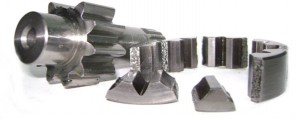
Not so long ago I wrote about the peculiar design choice that SUN hydraulics made to their cartridge valves - the replacement of the steel wire circlip with a plastic retaining ring, and I've had the parts from the DODS cartridge that I used for the example lying on my desk ever since.

As I was going to (finally) store it away in my SUN Hydraulics scrap box, a thought crossed my mind: "This is such a well-designed cartridge valve - it's a shame that its beauty stays hidden from our eyes!" A shame indeed - you really need to physically take it apart to see how it functions, because folks at SUN hydraulics made it their mission to never do justice to their designs in the cutaway drawings displayed on their otherwise well-polished website. This is what I am talking about:

This cutaway view is what's currently being displayed on the official DODS page. It has a whopping 397 by 163 pixels resolution that reminds me of the time when I worked at an office with a telefax machine that was connected to a land line and used rolls of thermal paper for printing. Props to you if this reference rings a bell.
I wonder if there's a whole department that decides on the exact amount of blurriness and pixelation a public cutaway view of a cartridge must have to make it look exactly between "good" and "bad." I don't think I'll ever understand this, but since I have this particular cartridge valve - the DODSXHN - lying in front of me in bits and pieces, I guess I can make a drawing of my own.

This is a normally-open, pilot-to-close, balanced-poppet cartridge valve. I hope that my model makes its function super clear, and you can see how this design balances out the work-port pressure-induced forces acting on the poppet. Also, note the floating-style construction that prevents the internal parts from deforming and consequently binding due to excessive installation torque or a slight cavity misalignment, and also the fact that both the drain and the pilot ports are positively sealed. I wonder what would be the drain flow? One drop per... week? A note: these drawings do not contain the (infamous) plastic retainer ring that holds the nose of the cartridge in place.


I believe that studying designs of cartridge valves is important for hydraulic technicians because it arms us with a unique knowledge of how they function internally and, consequently, allows us to imagine the ways they can fail, which is invaluable when diagnosing hydraulic equipment that employs such valves.