
Insane Hydraulics
Bold and audacious blog about fluid power
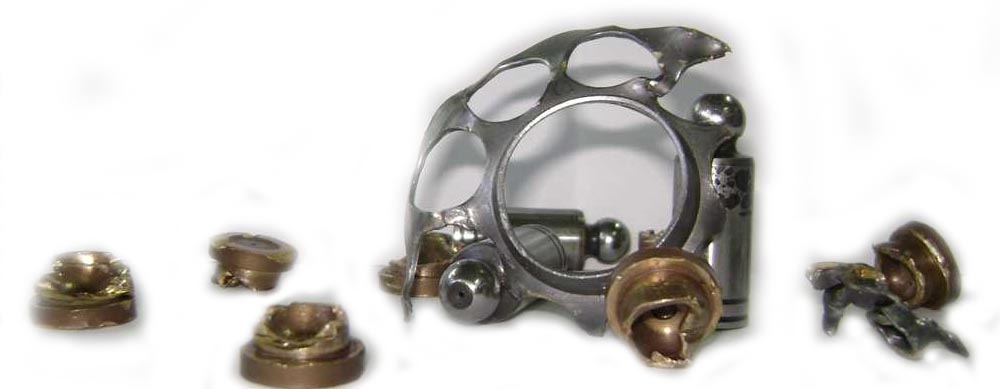
The relief valve is one of the first basic components you learn when you enter the world of hydraulics, which makes perfect sense, because most of the times it is the component that prevents all the other hydraulic components from exploding. You learn that its function is important, its correct adjustment is essential, and fiddling with it is very dangerous.
Even people who are not hydraulic specialists, but have been around hydraulic equipment long enough, have a general idea of what a pressure relief valve looks like and understand that its main purpose is to limit pressure. This is good, because the valves are important, and this is bad, because there will always be fearless fellows, who will tamper with the relief valves every time their machinery has an "insufficient pressure" symptom before calling for professional hydraulic help.
It would be OK, if they left the adjustments as they "found them", but it never happens. In most cases the poor valves end up adjusted to ridiculously abnormal values or even completely blocked.
This is much more common than you might think, and that's why it is very important to verify correct adjustment and function of a pressure relief valve whenever you test a hydraulic system or a component equipped with one. Unfortunately, even experienced technicians can forget or even intentionally omit this simple step.
An example I saw this morning - a tiny power-pack test. The power-pack was dead simple - an electric motor, a group 1 pump, a tank, a pressure gauge, a manual directional control and a relief valve - that's it. The technician testing the rig had many years of experience, which was promising a quick and painless test...
It was the unusual noise the power-pack made when the it was turned on that caught my attention. As I glanced across the shop, I could see the analogue pressure gauge from a 10 meter distance. I wasn't able to see the reading, but I could see the pointer at the end of the scale, and I knew it was a 400 bar gauge. A thought crossed my mind - 400 bars - gear pump - oh-oh! The motor was immediately shut down, and, luckily, the pump withstood the offensive treatment with pride. It did give the technician something to think about, though...
I have seen this situation (with variations, of course) way too many times - a hydraulic machine "looses pressure", and the relief valve "extravaganza" begins. The "fiddler" (who usually believes a common myth that all hydraulic valves are made on a "turn clockwise = increase" basis) turns the adjusting screw one turn in - nothing changes, another - nothing again, yet another - nothing! (this troubleshooting technique is described in detail here) Then says something like - Well, my work here is done, give the rig to them hydraulics guys, they'll know what to do about it!... Sounds familiar, doesn't it?
Another similar attitude I get to see way more often than I'd like is the "enthusiastic over-adjustment" of pressure relief valves incorporated in closed loop hydraulic pumps (I am referring to the models that have those valves adjustable, of course). Normally, such pumps have two separate pressure limiting systems - one that limits pressure by destroking the pump (like the cut-off valve in A4VGs), and one that limits pressure through cross-port relief action. As a rule, the former serves to actually limit the system pressure, while the latter - to cut pressure spikes, i.e. limit pressure when the first system wasn't fast enough. This is why the cut-off setting is some 30-50 bars lower than the relief, and is the reason the relief valves may "skip" verification when a mechanic assumes that, as long as their setting is higher than the pressure cut-off setting, it is "presumably OK".
Skipping the verification of the adjustment value of these valves does save time and trouble (sometimes quite a lot of trouble, due to the condition and the position of the adjusting screws) but is a bad habit due to the exact same reason I described above - it is probable that when the first signs of "pressure loss" appeared, someone had tried to "fix" the problem by tampering with the pressure relief valves, most likely leaving them blocked!
I also believe that besides simply checking a relief valve's setting, it is also very important to check it's adjustability by lowering and increasing the adjustment value to check its response and repeatability. It may help you discover a malfunctioning valve you wouldn't find otherwise, and will give you an idea of the valve's bars-per-turn ratio, which is a handy reference.
So, to resume - whenever you come across a pressure relief valve in a malfunctioning hydraulic system, always check both its setting and adjustability. It might take you an extra minute but is a good practice, which in the long run will pay back. Whenever you are about to re-commission a machine that had gotten a new or overhauled pump, make it a habit of yours to at least identify the main pressure relief to see if it had been tampered with, although the safest practice would still be loosening the adjusting screw and starting a machine or a power-pack with a low limiter setting.
In fact, no matter what hydraulic machine, rig, pump or motor you are testing, do not ask yourself whether to test or not to test this or that part of it - think of a way to test it! Practice shows that parts labeled "presumably OK" are often the ones to cause the malfunction in the first place, so when I am asked a question "to test or not to test?" I always respond "test!"