
Insane Hydraulics
Bold and audacious blog about fluid power
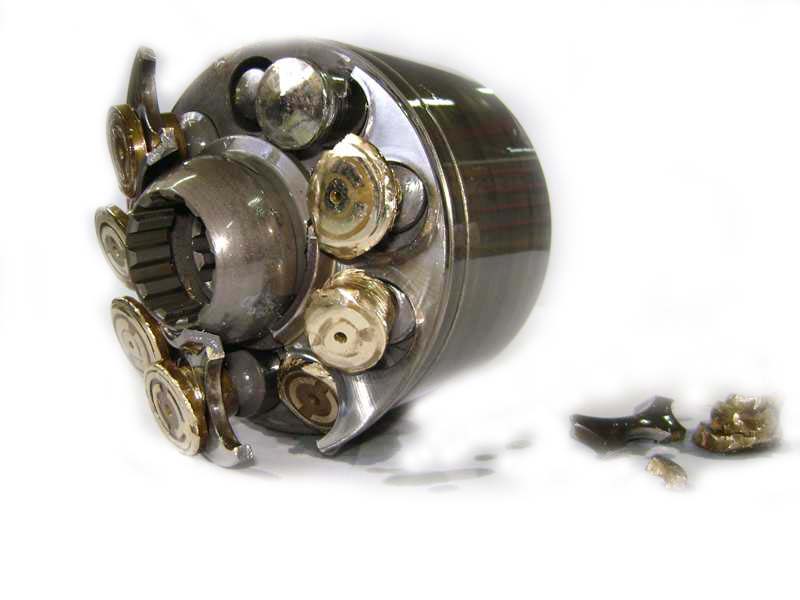
Many times in my career I've seen the topic of suction line filtration become the subject of doubt and debate. Believe it or not, I still hear viewpoints of experienced technicians and engineers vary from "never" to "always". And when hydraulic equipment owners and operators ask about my angle on this subject, their reactions to my reasoning range from "was blind, but now I see" to "I should like to challenge you to a duel!"
One thing is certain, though - suction filters have been around for decades. I consider this fact alone to be the main reason why there are so many people who view the use of suction filters as something highly beneficial if not mandatory. In this post I will explain why I am convinced that suction filtration is vastly overrated, and why the use of suction filters in modern hydraulic systems (with very few exceptions) can only be explained by blind tradition following and nothing else.
Tradition is beliefs handed down from generation to generation, and since a lot of currently active technicians have acquired most of their hydraulic knowledge through hands-on practice and colleague advice, it's perfectly natural for them to follow their company convention without question. So, if their "mother shop" has always installed suction strainers, there is no reason for them not to follow and defend this practice.
Even one of the best sources of current technical information - the manufacturer catalogs - is no stranger to bias, and if you want to use them to educate yourself in modern filtration technologies, you will have to filter out "slogans from the past" and concentrate your attention on bare facts. Although many brands did carefully change or even completely exclude the description of suction filtration advantages from their catalogs, you can still find phrases like:
All of the above was copied from leading manufacturer websites and their downloadable catalogs, and if you like, you can easily google for the source.
Clearly, such statements coming from respectable sources make it very easy for someone with little industrial experience to recognize suction filters as some kind of universally recommended "pump protectors". Plus our common sense tells us that if we want to "stop contamination", we must do it at the very beginning of the "pumping process", therefore the suction line is the most logical place for a filter. Well, logical - perhaps yes, but practical and justified? - A careful consideration must take place in order to answer this question. So then why don't we do just that? - Let us consider the conditions, in which most suction filters operate, and let us carefully examine their advantages and disadvantages.
But first, let's take a minute to define the vocabulary. Suction filters come in all shapes and sizes, but in general, any filter line will offer two "flavors" - namely internally and externally mounted. Internally mounted filters are, basically, wire mesh strainers that are screwed on a suction pipe inside the oil tank, while externally mounted filters are their more sophisticated younger brothers, whose distinguishing feature is the fact that they can be serviced from outside of the tank. In order to simplify things, hereinafter the former will be referred to as suction strainers, and the latter as suction filters. (I understand that this, obviously, is not correct, as all strainers are filters, but not all filters are strainers, but I wanted clear and short terms to separate these two types in the scope of this article).
All possible problems with suction filtration stem from the fact that these filters and strainers are mounted, well, in suction lines of pumps. And a hydraulic pump suction line is a very special place, where the maximum flow-driving positive pressure is a fixed value, defined by the sum of the oil head above the pump inlet and the internal tank pressure. This pressure is usually very low, especially in atmospheric and low-profile tanks. The fact that the suction line is "fed" by a fixed pressure source is what gives these lines their peculiar "reaction" to any type of flow restriction.
While restriction in a return line, a pressure line, or any other line fed by a positive displacement mechanism, will cause the oil pressure to rise before the restriction point, putting a restriction in the suction line will cause the pressure to drop after the restriction point. Pause and consider that for one second - any restriction in the suction line will cause the already low flow-driving pressure to drop even lower downstream the restriction point!
Any kind of barrier filter is a restriction point by definition. If it is not much of a choke when new, it will become one sooner or later due to particle loading, varnish deposit, an increase of oil viscosity, or something else, and what do we have downstream of our suction filter? That's right - the inlet of our hydraulic pump! And we all know that the lower the pressure in a pump inlet the greater is the chance of cavitation and the bigger is the mechanical stress on the rotary group components (especially in axial piston and vane units). In short - as the inlet pressure goes down so does the life span of the pump! Allow me to rephrase - any type of suction filter or strainer reduces the possible life span of a pump it's connected to.
To be completely fair, let us make a list of the strong and weak points of suction filtration:
So, when you use suction filtration what you get is - expense, shortened pump life, a real risk of catastrophic pump failure if maintenance is skipped, questionable filtration, and not much of anything else. A classic situation when the risks outweigh the benefits!
Strainers are just not needed, period. Using a suction strainer is like opening an umbrella indoors to protect you from the rain outside - if your roof leaks, the umbrella does keep you dry, however, shouldn't you be fixing the roof instead of relying on an umbrella? And if the roof is OK, then what are you doing with an open umbrella indoors?
But what about those suction filters? It kind of seems like they can actually make technical sense, because they are accessible, serviceable, capture metal particulate with magnets, and even do more than that, right?
Well... Firstly, there isn't much economical sense to them, since what can be called a "decent" suction filter with a high-efficiency element can be as expensive as a pressure filter rated for the same flow, and secondly - just think about this whole suction filtration "fashion" for a second - it is not that you can not find a clever way to circumvent all of the disadvantages stated above - technically it is doable. Hell, you can choose a micro-fiberglass multilayer suction filter the size of a truck, connect it to an oil tank with a 10-meter oil head above the inlet, and monitor the crap out of it with digital vacuum meters, and it will be safe and it will secure ideal oil conditions! However - all of these clever solutions are rendered unnecessary by other common types of filtration, like pressure, return and off-line coupled to a decent breather, as long as the tank starts up clean!
If you want to experience how a pump feels when you slap a strainer (or a filter) on its inlet, run a marathon while wearing this. I guarantee that it will keep you protected from contamination during the race, and as an added benefit, will give you that S.T.A.L.K.E.R Shadow of Chernobyl touch. You can tell me how you feel about suction filtration at the finish line.
The only place in a hydraulic system where I would consider (consider!) installing a properly oversized suction filter would be a suction line of a relatively small closed-loop charge pump, although I still prefer pressure side filtration for the charge circuits any day. The analogy here is different - when I think of a suction strainer connected to a large open loop pump, I imagine an adult person running with a gas mask on, however putting a suction filter to protect a charge pump of a closed-loop transmission is like putting a delicate baby in a sterile incubator. Note, however, that this still makes sense only for small charge pumps. Large closed loops should stick to pressure filtration of the charge flow.
A separate word must be said about the so-called magnetic filters. I have no experience with them, but I believe this technology has a future, especially with efficient magnet arrangements like, for example, in Magnom Filters. They do have a line of products that can be mounted on suction lines - and this is something I would consider using, even if it were just to test the efficiency of this type of filtration (which I just might do in the future).
And now, as promised, an explanation of the biggest (in my opinion) advantage of suction strainers and filters, namely, their ability to serve as perfect "slacker tell-tales".
Everything I have said so far about suction filtration is best applied to new projects. But what about already existing builds? If we follow the technical logic described above, we should remove a suction strainer or a filter whenever we come across one, shouldn't we? And to this, my friends, I respond the following:
Any hydraulic system is or will be inserted into a certain environment, and it is this environment that defines its operating conditions. Any environment consists of two parts - physical and human, out of which the latter will always override the former!
If a hydraulic power-pack is mounted in a cool and sterile room, but the maintenance is poor or inexistent, the operators use the filler cap as an ash-tray, and the tank is refilled from a dirty jerry-can only when the low-level alarm goes off, you can say that this system operates in extremely harsh conditions. Likewise, if you have a hydraulic system running next to a rock-crusher inside a mine, but the maintenance crew are properly professional and know what work ethic is, this system, however unlikely this may sound, is operating in much better conditions than the first one.
When you are building a new hydraulic system, you can resolve the physical environment at the design stage, but you will never determine the human environment before the system has operated for at least half a year! And that is when the above mentioned "slacker tell-tale" ability of suction strainers and filters comes into play:
When you happen to service an existing hydraulic system, originally equipped with a suction strainer or filter - inspecting it will give you a very precise clue about the human environment. When you inspect the old filtering element - if it is visually clean - you can safely remove it from the system. However, if you find a lot of "foreign material" blocking the mesh, it can only mean one thing - the human environment of this particular piece of hydraulic equipment consists primarily of slackers (hence "slacker tell-tale"), and even if you clean the tank, reinstall the missing filler cap, reinstall the missing breather, reinstall a hundred of other things that are missing, and do whatever you can to make things better for the poor unit - it won't matter! The slackers will make sure that the oil in the tank returns to its previous condition in a matter of days!
In this case (positive "slacker" test) I would advise (against all technical reason) to keep the suction strainer or filter. Better even - replace it and charge for it. Don't worry about the reduced life span of the pump and don't mention it! Such equipment owners have absolutely deserved their right to suction filtration!
For new projects - forget about suction filters and strainers, they are unnecessary. For existing builds - if your hydraulic system has them for the sake of having - remove them, if your hydraulic system needs them - it is not a good system. Consider this next time you design, order, or service a piece of hydraulic equipment.