
Insane Hydraulics
Bold and audacious blog about fluid power
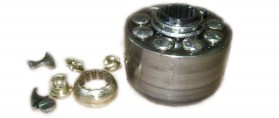
This post is about "broken" hydraulic pumps that aren't broken. Yes, there is that kind of pumps, and every once in a while one of them crashes at our workshop, making me wonder what the hell it's doing here.
My main craft is hydraulic pump and motor repair. I like doing it, I've been doing it for a long time and even dare say that I am "relatively" good at it, so you can take my word for it when I say that not all "broken" hydraulic pumps and motors, brought to a workshop to be repaired, are really broken!
This may sound a little extreme, but it is true, and this fact is well known to all hydraulic workshop owners, who will also confirm that in 99 cases out of 100 this happens due to inadequate troubleshooting, the term "inadequate" in this context standing for "incompetent and/or hunch-based".
From what I've seen so far, such "broken not broken" pumps and motors can be divided into the following three categories:
This category can actually be subdivided into two sub-categories: "the victims of the pump myth" and the "misdiagnosed":
There is a very persistent myth that when a hydraulic system is "lacking force" or "becoming slow" then the main pump is the culprit. I would estimate that this myth alone accounts for about 15 - 20 percent of our pump overhauls and new unit sales. I am very grateful that it exists.
A faulty relief valve, a defective actuator, an electrical problem, a prime mover problem - you name it - so many things that can go wrong in a hydraulic system, and yet - it is always the pump! Do you need to remove an appendix every time a person feels abdominal pain? Need I say anything else?
Aside from the "pump myth", there's also a place for perfectly functional units that's been misdiagnosed. Such units deserve some respect because at least some form of troubleshooting was performed.
Just last week I received a Rexroth A6VM hydraulic motor in perfect condition. When I opened it and verified that it had zero wear, I called the client and asked why the motor had been sent out for an overhaul. As it turned out, it had been tested by a "certified mechanic", who asserted an excessive case flow. When I asked if he had taken into account the fact that the motor had a flushing valve, I got - "Er... Flushing what?.."
I won't be too harsh on the motor, but it will get a new seal kit, and I will bill the repair and the bench test, so, I guess... thank you, Mr. certified mechanic?..
Variable displacement units rule this category. And most of the time the need for re-adjustment appears after "somebody tried something". Closed-loop null, automotive control setting, pressure compensator (be it a pump or a motor), and my personal favorite - the towing bypass valve - they all "get the wrench" first and then end up on our benches.
Need an example? A couple of months ago I received a Rexroth A4VG pump with an automotive control, absolutely new parts inside, no wear whatsoever. The loader was acquired pretty cheap because the "transmission was broken". The previous owner had paid for a complete pump overhaul (and by complete I mean - the whole shebang - the rotary group, the swashplate, the bearings, the seals...), and after several workshops failed to get the machine moving (including the company that did the overhaul), he'd given up and auctioned the loader out. Would you believe me if I told you that the inching lever of the DA valve was blocked in the "OFF" position?!
I am referring to stuff like fried coils, clogged filters, obstructed orifices, stuck valves, etc... Something that you can easily diagnose and fix without removing the pump. Although in this case the units are indeed problematic, still their disassembly is not the best choice.
My point is - every time such an "excessive overhaul" happens, thousands of euros get spent without any particular need for that. One could argue endlessly about the commercial side of the question, stating that, since workshops find themselves at the receiving end of the money path, these situations shouldn't be considered as something bad, and I can relate to that. But being an industrial junkie, I will always defend the technical side over the commercial, and this is why I, for the millionths time, will repeat something I say almost every day to people seeking troubleshooting advice:
Never dismount a pump or a motor (or any other component, for that matter) without confirming its malfunction and making sure it can't be fixed on the spot!
Efficient troubleshooting is a logical and systematic search for the origin of the problem. Hunch-based troubleshooting, on the other hand, is a form of witchcraft, which is fun to look at and, truth be told, is capable of occasionally delivering positive results, but when applied on a regular basis is a direct road to bankruptcy.
Logical and systematic means that:
You wouldn't believe me if I told you how many times I am asked to repair (often urgently) perfectly functional units! And, despite all I just said, I know for sure that I will be asked that again and again... There's a conviction in my heart, however, that readers of this blog will never be the ones responsible for this!