
Insane Hydraulics
Bold and audacious blog about fluid power
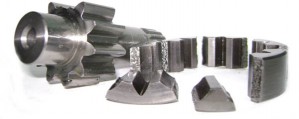
Not a day passes without someone bringing over a gear pump to "see if it is OK". The usual backstory is - the machine has "lost pressure" and, of course, the gear pump is the primary suspect. Indeed, why test anything when you can just take the pump to local hydraulics dealers and get their "professional" opinion?!
After about a year of working in a shop I knew for sure how to evaluate a gear pump just by looking at its parts. Some five years later, however, my visual evaluations became much more reserved, as I had seen gear pumps with severely scored parts present perfectly good efficiency, and pumps that looked brand new fail bench tests at 100 bar, with everybody betting their reputation and years of experience that they should work.
It's obvious that when a gear pump has excessive wear, there is not much you can do but replace it. But before dismounting any component from a machine, you must make sure you're dismounting the "root" of the problem. Experience tells me that indeed, in most "not enough pressure" cases the pump is the guilty one, BUT, experience also tells me that most cases aren't all cases. Going for the pump every time you encounter a "pressure-less" machine, is like insisting on a heart-surgery every time you feel chest pain.
There is, however, a very simple way to discover if a gear pump has "volumetric issues". When a pump wears-out, its sealing clearances become larger, which causes reduction of "useful" flow and an increase of the internal leakage. When leakage flow is big enough to become a pressure limiting factor, all of the input power is transformed into heat, and the pump essentially becomes an industrial oil-heater. While in case of a piston pump a large part of the generated heat would be carried away with the drain flow, in a "drain-less" piston pump all of the generated heat is concentrated inside the relatively small body, causing an instant and very confined overheating, which is an easily detectable indicator of a busted gear pump.
Take, for example, a system that runs a 16 cm3 gear pump at 1450 rpm, and, say, the system pressure can't go higher than 100 bar because the pump is worn-out. You're looking at a 23*100/600=3.8 kW heater! How fast do you think will a couple of kilograms of aluminum heat up? With the specific heat capacity of about 1 J/gC, a 3 kW thermal input will heat 3000 grams of aluminum at the rate of one degree C per second (roughly 2ºF per second), which means that in less than a minute the body will become "burning hot".
In other words - if a gear pump heats up very-very fast when a hydraulic system is "dead-headed" - you can scrap it! The only thing missing now is the consensus over which would be the best practice to detect this instant overheating.
"Scientific" methods that rely on the use of infra-red or contact thermometers are boring. The "hands-on" trick is so much more fun! All you need to do is let the machine cool down to "warm", start it, put your hand on the body of the pump, and raise the pressure (by extending one of the jacks till it hits the end of stroke, for example). If the pump is "bad", you will feel the temperature increase instantly - in a matter of seconds you'll have to take your hand off of it. However if the pump is not the problem, you'll feel no significant temperature rise.
I can imagine there are people who deem measuring of hydraulic components temperature "by hand" unsafe, and I understand this, and even agree, but only to some extent. I am not talking about putting your hand on a high pressure hose here, I am talking about putting a hand on a COLD surface that is ABOUT TO get hot. Unless you're retarded, you'll know when to take the hand off.
So, whenever you detect insufficient pressure in a gear pump driven hydraulic system, check the pump body for "instant overheating". If you don't detect it, there's a good chance the problem is elsewhere. If you do see the pump heat up instantly - you just found your culprit, and it took you but a couple of minutes!
For the record, the infrared thermometer is one of my most favorite tools I never leave home without...