
Insane Hydraulics
Bold and audacious blog about fluid power




I am often asked about the best way of flushing contaminated lines of a closed loop that suffered a catastrophic failure. I can't really give a definite answer to this question, simply because there are so many ways to "skin this cat", but I can give a short description of one flushing technique that I've used for years, and that hasn't let me down so far.
Closed loops are everywhere, and luckily for hydraulic businesses they break all the time, causing workshop owners to grin when a simple seal-kit overhaul is needed, to beam when a rotary group needs to be replaced, and to laugh heartily while rubbing (alternatively clapping) hands when a major failure causes a complete transmission to drop dead. All the grinning, beaming and diabolical laughter is performed after the client has left the shop, naturally...
After a damaged closed-loop pump or motor is repaired and re-installed on the machine, special care must be given to circuit cleanliness and in particular to the loop lines, to guarantee that the recently rebuilt unit doesn't "expire" the moment it starts turning. This is especially vital in case of interventions caused by major failures when, more often than not, the loop lines get contaminated with all sorts of debris that can destroy the new transmission in a matter of minutes unless removed from the circuit.
When the loop is simple and the hoses are short and easy to dismount, a mechanical cleaning (with brushes, air projectiles, solvents, etc...) is an easy way to get rid of the contaminants, but when the lines are extensive and the circuit is more complex, it may be next to impossible to dismount and clean all the hoses, and in this case, a flushing of the loop is mandatory before putting the machine back in service. There are various ways to perform this procedure, and in some cases, specialized equipment is indeed required, however, most of the time the following simple technique (aided, of course, by other re-commission must-dos and should-dos, like the mechanical cleaning of stuff that you can clean, filter and oil change, oil analysis and, most importantly, application of common sense) is enough to ensure safe recommission of a closed loop.
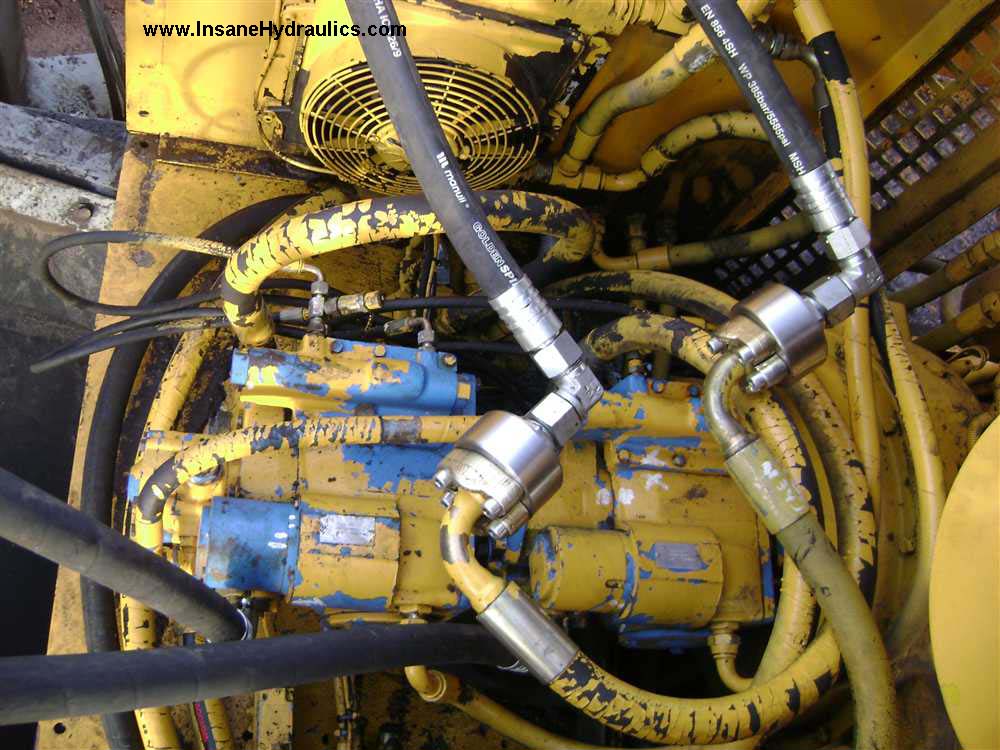
The technique resumes to bypassing the actuators, inserting a pressure filter in the loop, and using the pump itself to provide the flushing flow. These pictures show such a flushing procedure being performed on a Parker RT 16 mobile jaw crusher - a beautiful and intimidating piece of machinery, equipped with two closed-loop pumps that can work independently to move the tracks, or in conjunction to spin the crusher motor.
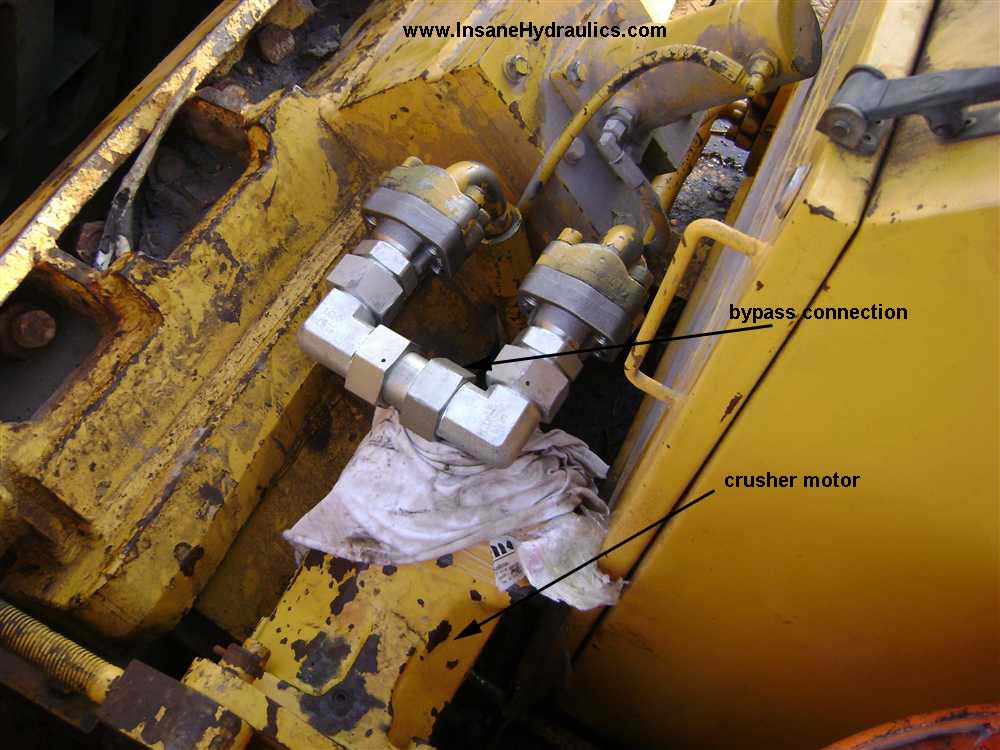
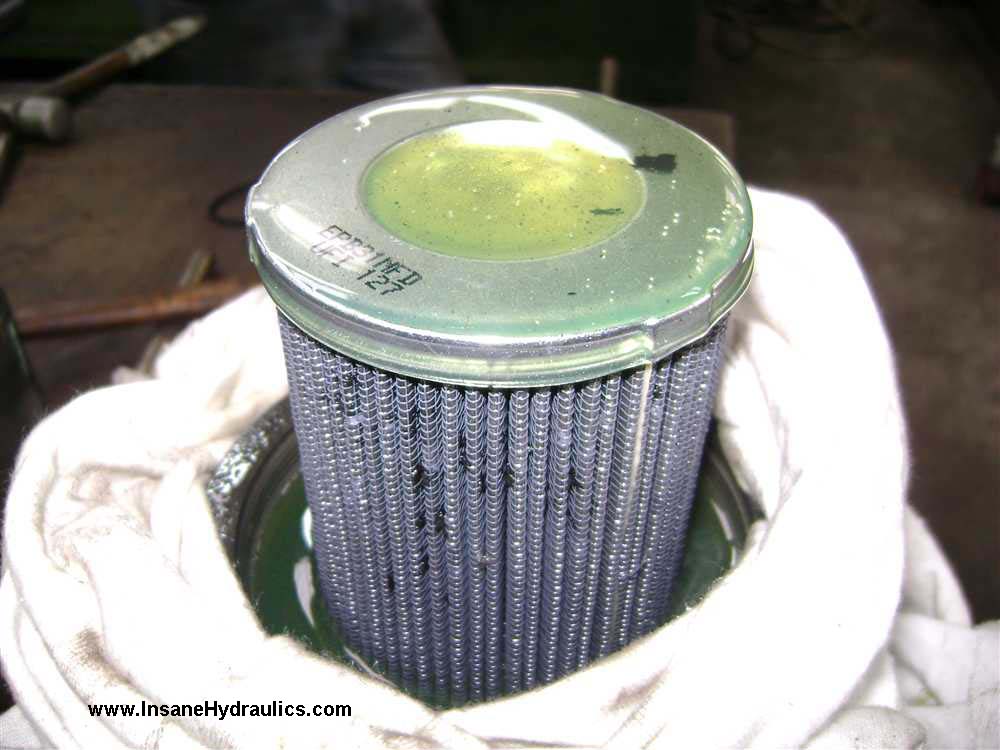
The assembly, consisting of a pressure filter, a check-valve, and a relief valve is introduced into the loop as close to the pump as possible (ideally - connected directly to one of the work ports with a clean hose). The idea is to flush out and catch any "nominal flow flush-able" contamination left in the loop and prevent it from entering the pump. The check valve guarantees that flow happens only in the desired direction (through filter to pump), and the relief valve makes sure the filter/hose/check-valve isn't blown away in case the pump is controlled in the wrong direction - a safe "dude, it's the other way round!" indicator, so to speak. Here are the two filter assemblies that I used for the crusher (the relief valve tank hoses aren't connected yet), one for each pump. And here are the traction motor and the crusher motor bypasses.
A quarter of an hour of full-speed operation at maximum displacement in both directions for traction and crusher circuits was enough to catch most of the garbage (note that when the flushing flow direction is changed, the filter assembly direction must be changed as well, although for many circuits a single direction flushing is enough). The hoses were reconnected and the crusher has worked problem-free ever since.
As you can see, this flushing technique doesn't require much gear (compared to an external power flushing cart, for example), and is relatively simple. It does have limitations, the biggest one being the fact that it can't provide "extra" flow that's needed for a "proper turbulent flow flushing", but it still is a good and relatively cheap way to assure healthy start-up for the majority of rebuilt closed loop transmissions. I applied it countless times and always got positive results.
P.S.
Once I got the crusher moving, I couldn't resist the temptation of putting random everyday objects in the path of the 50-ton track-driven critter... Another childhood dream come true thanks to hydraulics!