
Insane Hydraulics
Bold and audacious blog about fluid power
Before anything else, let us recapitulate part one:
Now - an imaginary example, to make things even clearer: You are asked to "take a look" at a hydrostatic transmission that "won't stay put". The first thing you do is check the type of pump control, and find that it's electric proportional feedback displacement control. Then you either mount two pressure gauges on both sides of the loop and apply the parking brake, or lift the machine off the ground (I didn't mention this technique in the first part, but, despite all the work, it is the safest way, as you can tweak the transmission all you like without the risk of passing over someone's foot). Then you install the by-pass valve in the servo-pressure test ports using appropriate fittings. The machine is heated to a normal working temperature and is at high idle. You activate (open) the by-pass and adjust the mechanical zero by turning the adjusting screw till the wheels stop (pressures level out), then you turn the screw in one direction and notice its position when the wheels start to move, then you turn it in the opposite direction and again notice its position when the wheels start to rotate in the opposite direction, then you lock it in the middle position. Then you close the by-pass and make sure the control is getting no input signal (or simply disconnect the control plug). Then you adjust the hydraulic zero, trying again to lock the adjustment in the middle of the deadband. Then you reconnect the signal wire and check if the null position remains unchanged after stroking the pump several times in both directions. And - you're done!
If you can't imagine what I am talking about, check out this "extremely pre-iPhone quality" video.
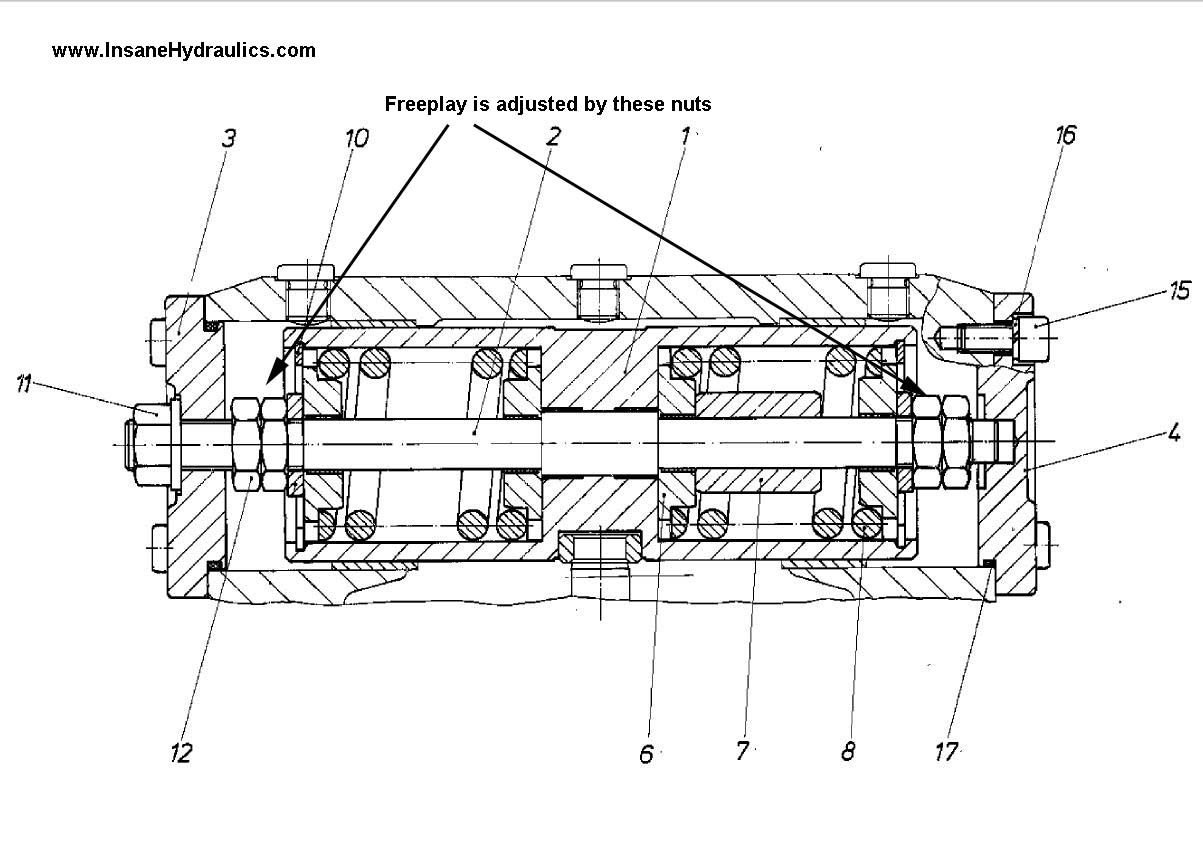
OK then, now we know how to adjust the correct null position of closed-loop pumps equipped with proportional displacement controls, but so far we have been looking at pumps that have only one mechanical null adjustment. In such designs, the mechanical freeplay of the pre-tensioned springs is next to none and is either set during the assembly, like in this example (A4V):
or isn't adjustable at all, like in this example:
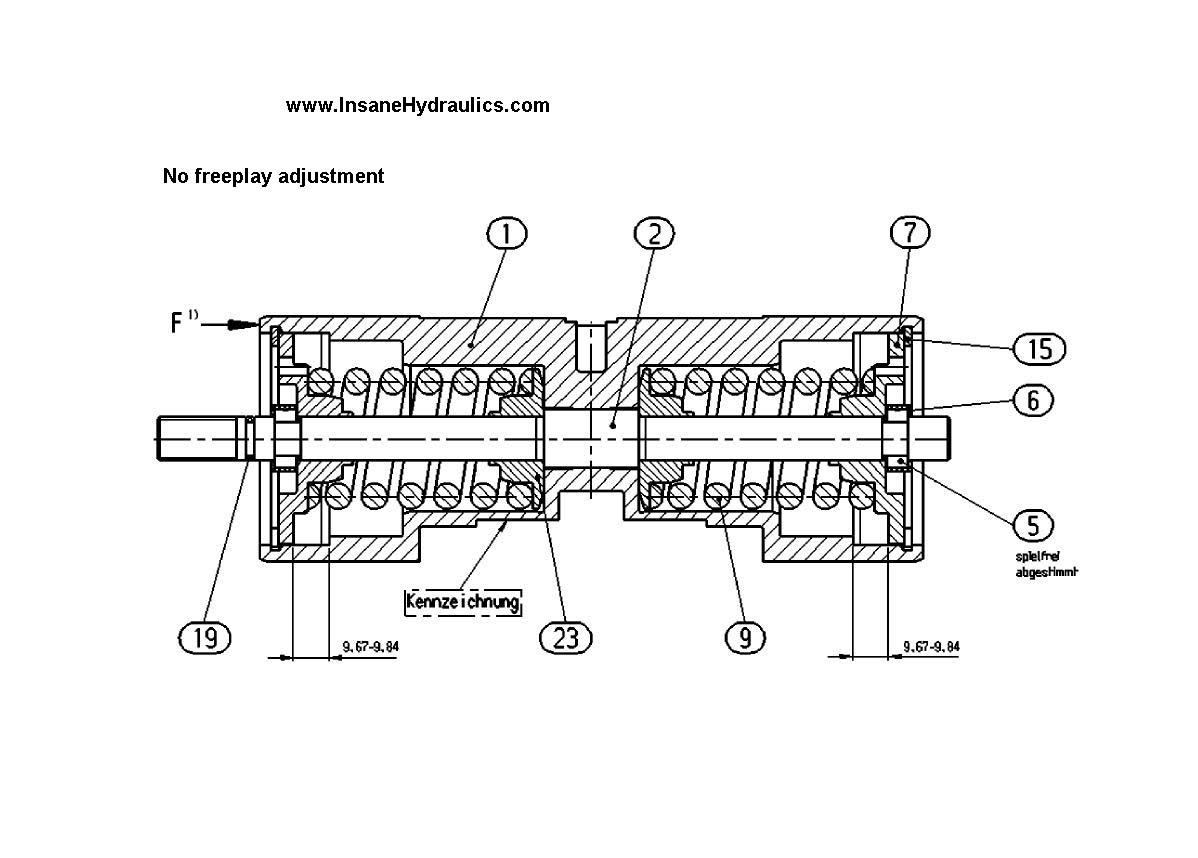
Such servo-mechanisms, when assembled or machined correctly, have practically zero freeplay to cause the unstable null condition, and the spring pre-tension creates servo-pressure deadband, defining the minimum servo-pressure necessary to make the servo-cylinder and the swash-plate move. This condition guarantees that the swash-plate will remain in a fixed position even with small servo-pressure fluctuations caused by the hydraulic positioning system.
There are, however, servo-mechanisms that use threaded servo-cylinders that position the servo-piston and the pre-tensioned springs attached to it. Such designs, when adjusted incorrectly, can allow for a substantial swashplate freeplay.
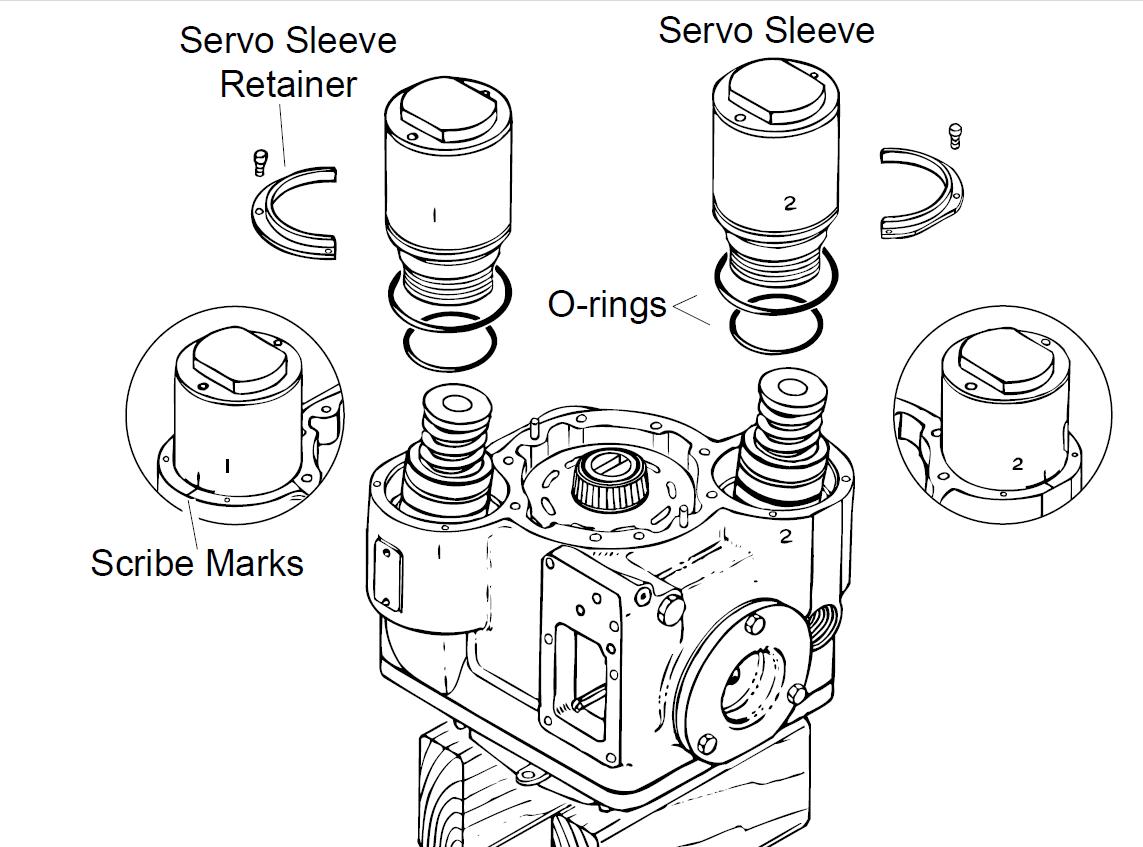
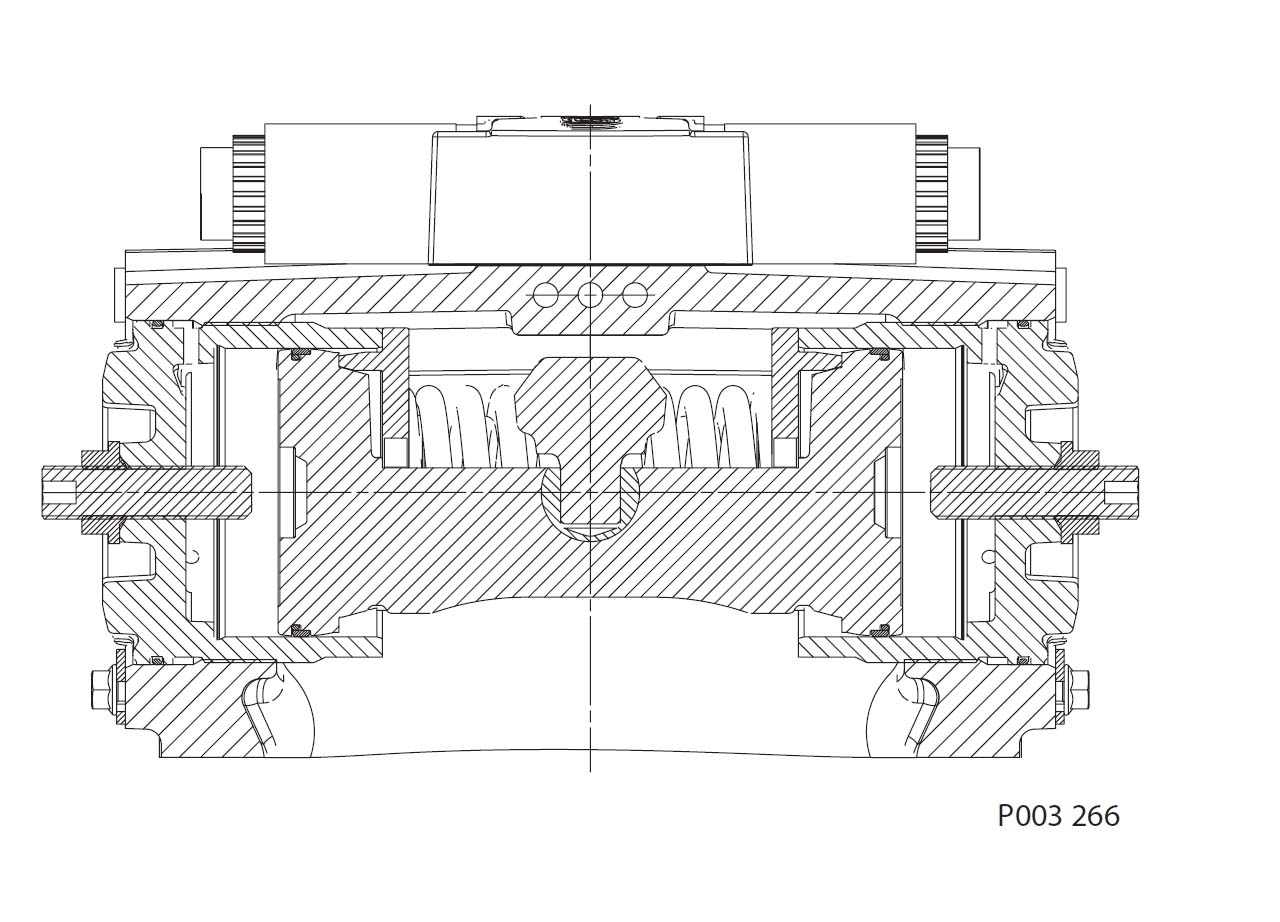
For example, in this classic servo-mechanism, or the newer one used in the Danfoss H1 series, one can unscrew the servo-cylinders, and the swashplate will no longer be held in place between the two pre-tensioned springs, becoming loose. The hydraulic null will still hold the swashplate in the neutral position, but it will be unstable (drifting null), especially if the hydraulic positioning system has wear, as there will be essentially no servo-pressure deadband. Furthermore, an incorrect position of the servo-pistons can cause incorrect displacement values, especially when the servo-pistons are too much in.
The correct servo-cylinder position for such systems is achieved when both the cylinders (the threaded sleeves) are just touching the pre-tensioned springs with the swashplate in neutral. Neither too much in, nor too much out - just touching - zero freeplay, servo-pressure deadband defined by the springs pre-tension - ideal mechanical null conditions to set the hydraulic null.
The best time to adjust the correct position of the servo-pistons in such pumps would be during the assembly, using special tools. But what if a mistake was made during the assembly, or, which is normally the case, someone had tampered with the adjustments? The servo-piston by-pass technique will be useless because the free play will make the hydraulic null system the only one responsible for positioning the swashplate, and even when you by-pass it, the swashplate will remain close to null due to the centering forces of the moving rotary group.
The following procedure is what I usually use in such cases. First of all, when I suspect that servo-cylinders were tampered with, I can't know whether they were screwed in or screwed out, so I unscrew both of the servo-cylinders, leaving the servo-piston intentionally loose. Then I block the pump's outlets by closing the restrictor (on a test bench) or applying brakes/locking the actuator (in the field). At this point, the swashplate position is defined by the hydraulic null. Then, if the null is off-center (which I can see by the pressure differential in the legs), I bring it back to center with the hydraulic null adjustment screw. Now the fun part begins, because people, who aren't familiar with this technique, get quite puzzled upon seeing the adjustment procedure. The next thing I do is turn the hydraulic null adjustment in one direction to the point where it causes the pressure in one of the lines to rise slightly. Just a little bit, maybe by 10 bar or so, only enough to make sure the swashplate is starting to tilt. When possible, it's useful to read servo-pressures at this point. The servo pressure differential created by such intentional off-center adjustment must be minimal. Then I screw in the opposite to the slightly pressurized servo-cylinder till the loop pressures level out and lock the cylinder in this position. The small servo-pressure differential guarantees that the pre-tensioned spring touches the servo-cylinder, but the pressure is not enough to compress the pre-tensioned spring, which means that I bring the swashplate to neutral by pushing on the pre-tensioned spring without compressing it and thus bring the servo-cylinder to the desired position - touching the servo-piston with the swashplate in neutral position! Next - I do the same to the other side. (Actually, the other side is a little bit easier to adjust, as the swashplate is already in neutral, and one of the cylinders is locked in the correct position. All I have to do is touch the servo-piston spring with the other cylinder, which is easy to feel - the moment it hits the pre-tensioned spring is indicated by the increase in torque). That's it! So very easy. Still in doubt? Check out this drawing (pdf version here):
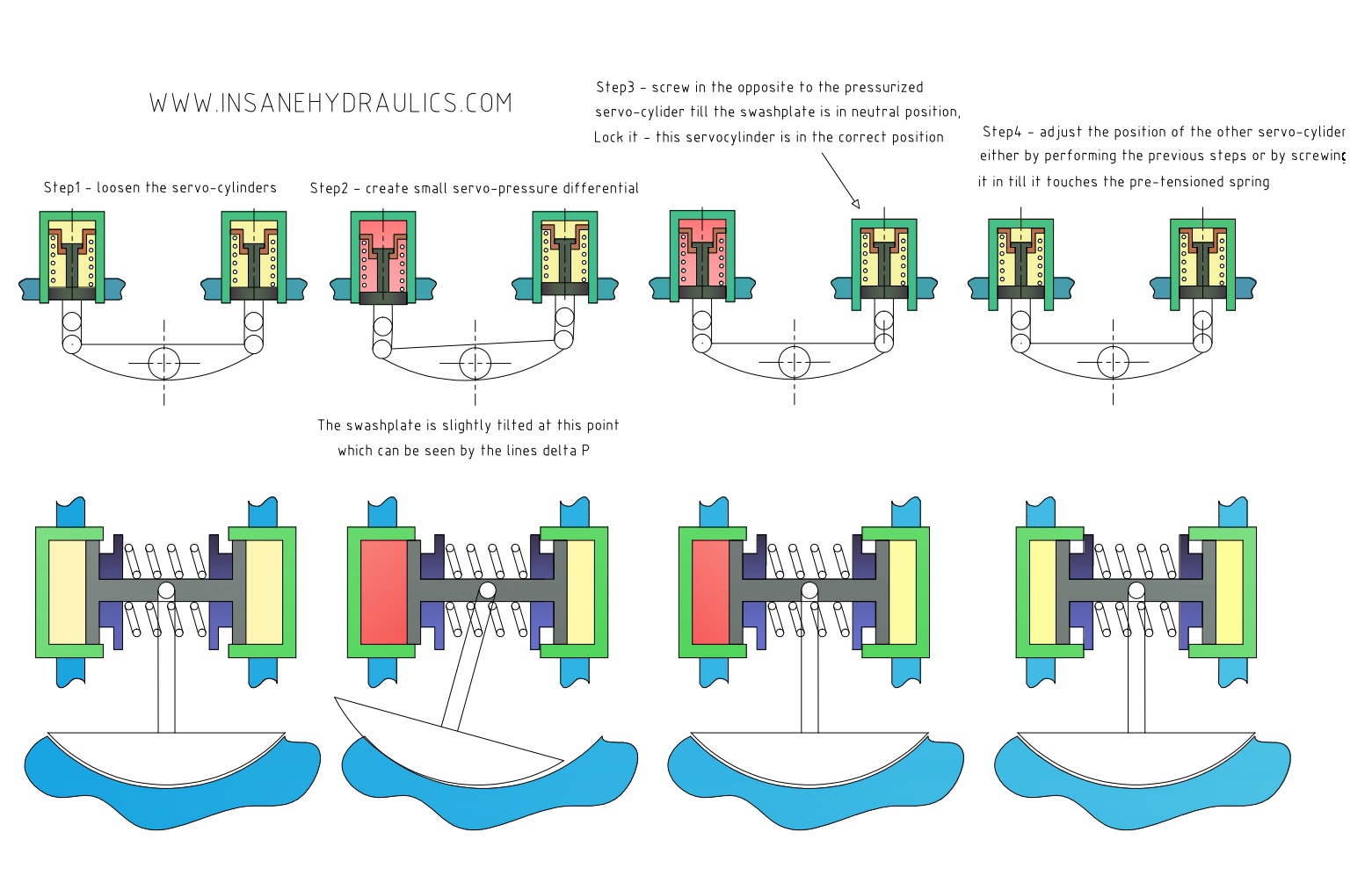
If you do this once, you'll learn it for life. By the way - the necessary servo-pressure differential can alternatively be created by supplying the pump with a small control signal, which can easily be done on a test bench but, in most cases, is impossible to perform safely in the field.
The most important thing is to understand how the above-described technique works, rather than blindly follow the instructions.
Well, that is it for this part. There's more in part 3, but even at this point I am dead certain that IH readers will never let their transmissions "run away"!