
Insane Hydraulics
Bold and audacious blog about fluid power
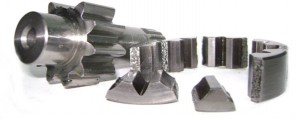
This battle shows that there is always a solution to any "unsolvable" hydraulic problem.
A colleague of mine asked me to have a look at a malfunctioning open loop pump from a 1270D forest harvester. It was a Rexroth A11VO190, that despite having gone through a complete overhaul (new cylinder block and everything...) was still "acting out" on the test bench. When I got my hands on it, I quickly discovered the problem - the load-sensing side of the control valve was severely worn out and had an enormous spool play and internal leakage. No Bueno! A new control valve was needed, and we had none in stock.
Foresters are like farmers - they are always in a hurry, and their machines run 24/7. Their contracts have tight deadlines and harsh penalties, so any unplanned stop is a stab in the back. I remember the times when the forest business was booming in Portugal, and you would be arriving at a forest crane with a hydraulic problem, with trucks already lining up to load timber before you even looked at the malfunctioning machine!
But this malfunction was bad. Bad in the sense that there wasn't much one could do to amend it. Nobody, not even the John Deere reps had either the control valve or a new pump in stock. The downtime was way too expensive for the client because he was at risk of losing the contract. The best we could do terms-wise was four weeks for a new control valve, and this was unacceptable! So, I needed to come up with a way to fix it, and fix it now, no matter what.
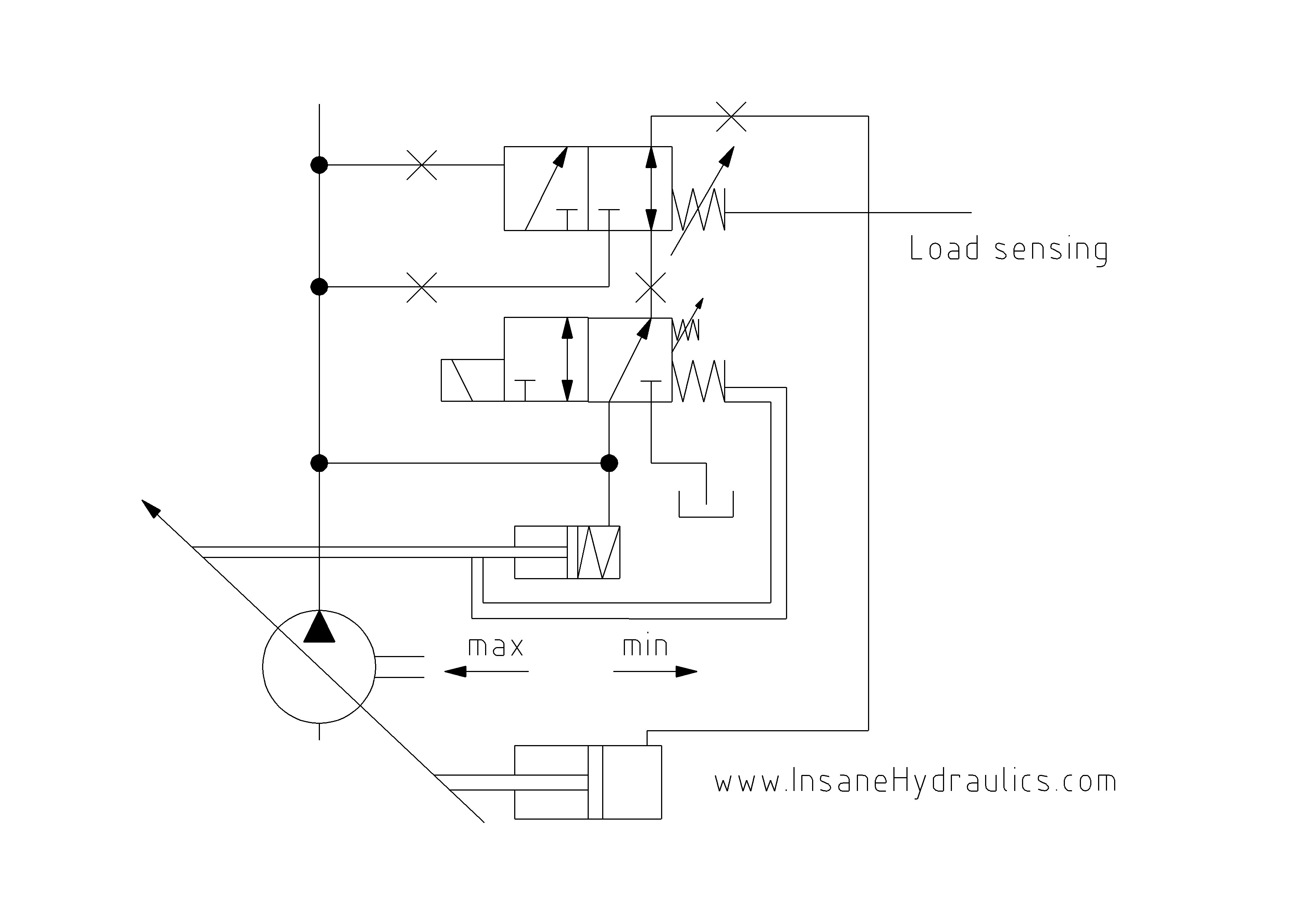
The control valve wasn't that complicated - it had a simple load-sensing spool coupled to an electric proportional stroke limiter with positive characteristic (orifices are omitted):

Even though the load sensing part of the control was pretty much busted, the stroke limiter was working fine, so, in theory, all I needed to do was isolate the load sensing side, make external ports, and use an external pilot valve for the load sensing function. Since we usually stock standard control valves for A10VO140 pumps, which have separate pressure compensator and load sensing manifolds, that conveniently come in a standard CETOP 3 (NG 06) form, finding an external LS control valve was not a problem. The crosses show where I would need to cut into the existing control:
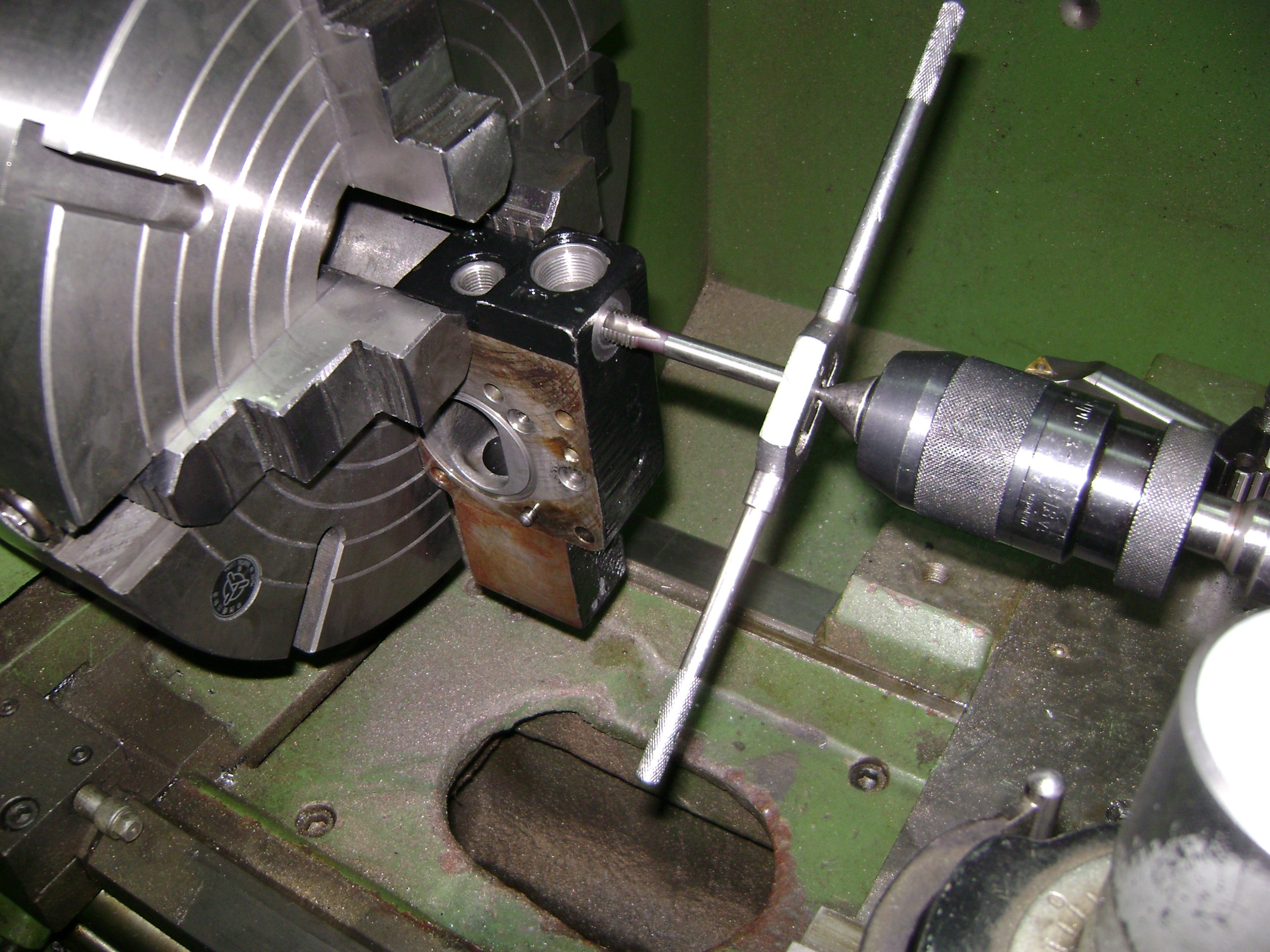
I called the client and asked for his permission to "invent", he gave it a "go", and I turned my "creative mode" on - drilling holes, making threads, and installing plugs. I connected the external LS valve with an NG06 base plate, a couple of pipes, and some 24º metric fittings:
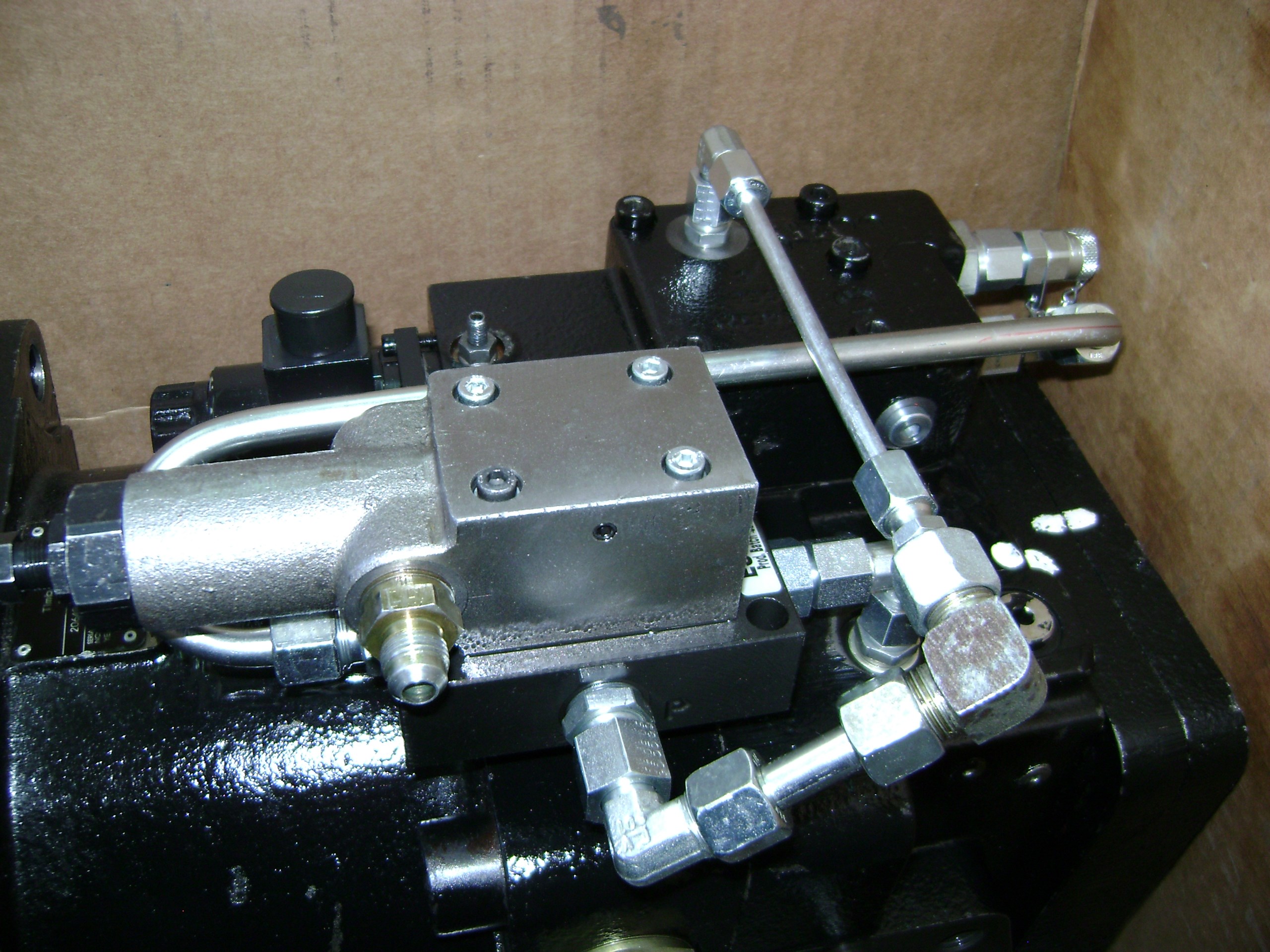
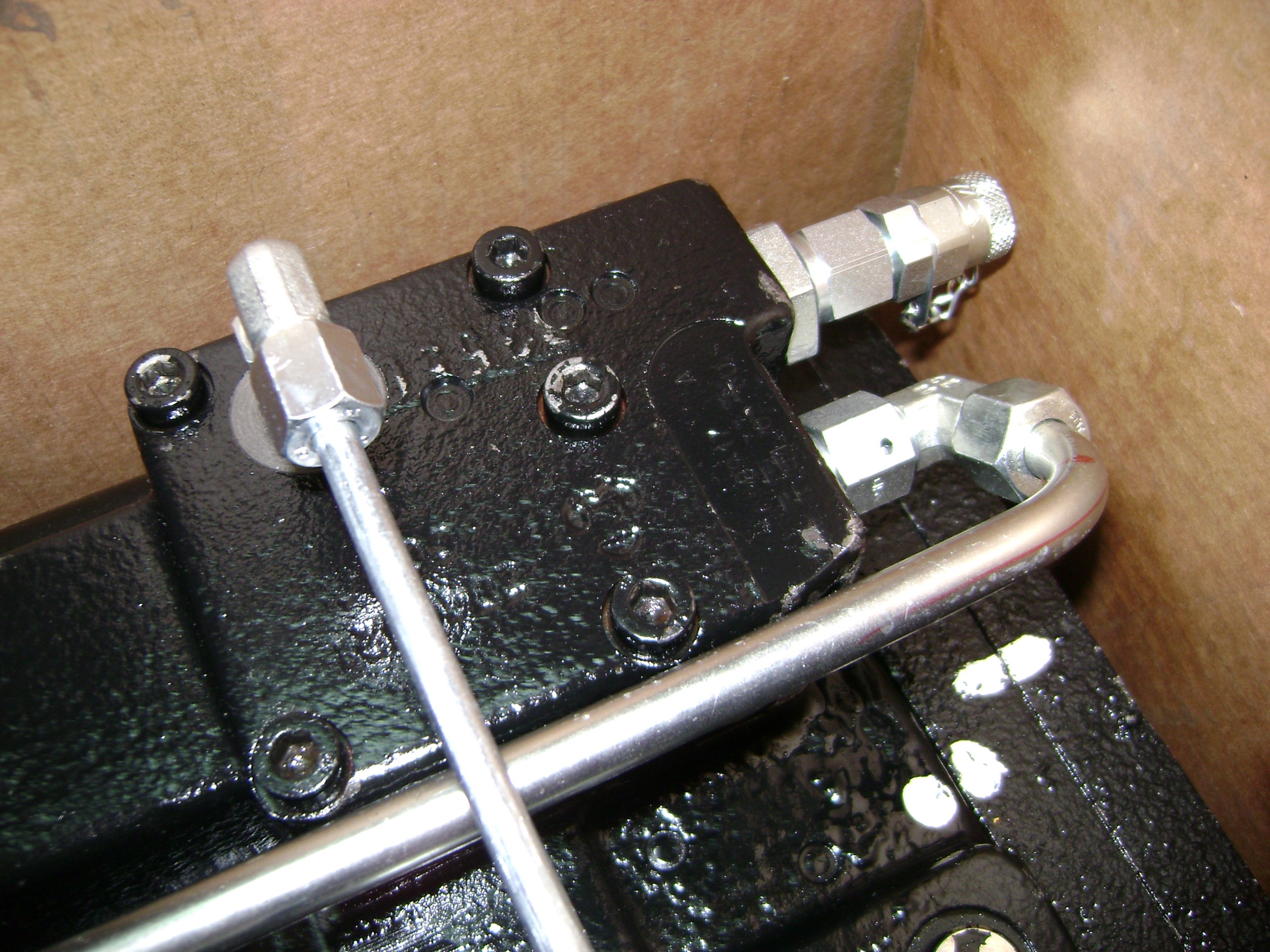
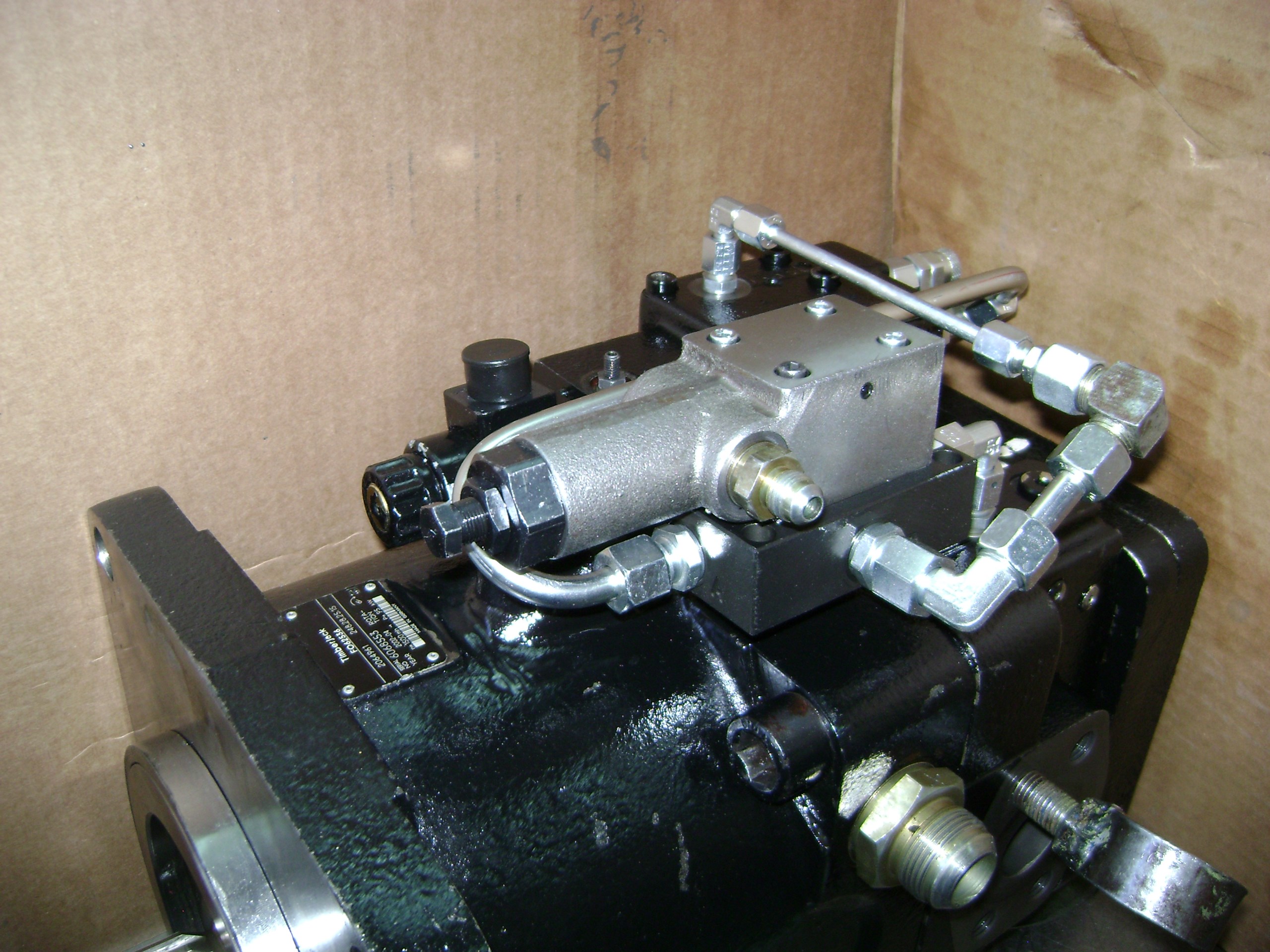
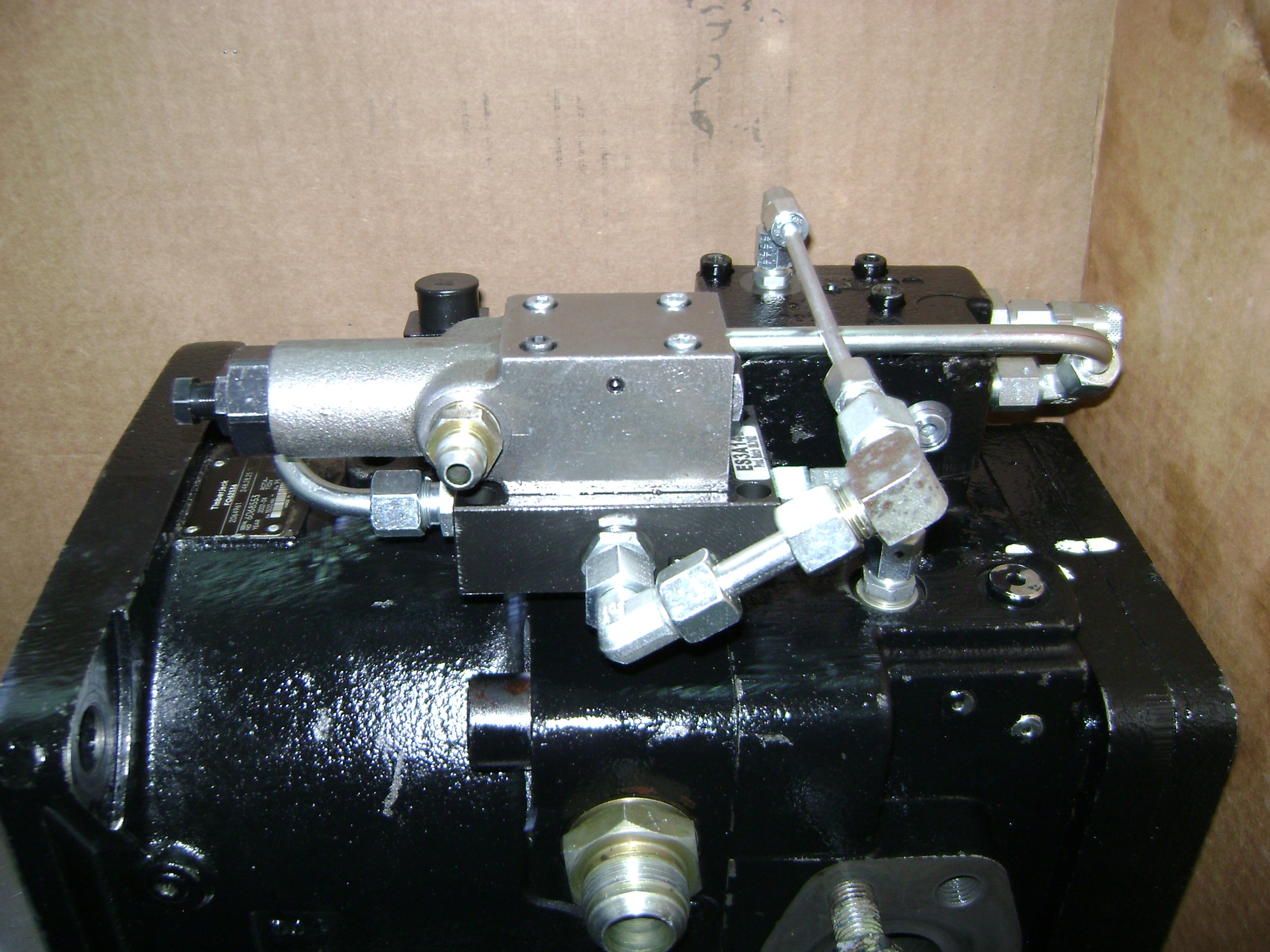
Strangely, the "Frankenstein" control valve worked perfectly fine on the test rig. I called the client and told him the "operation" had been a success. The next morning the pump was already working in the field and everybody was happy.
If you think it's the end of the story - it is not.
After about two hours of work the operator called me and told me the elbow fitting in the servo cylinder line failed, springing away and leaving the nut and the cut ring behind. Suspecting a deficient fitting I replaced it with a new one. A couple of hours later the new fitting failed, splitting clean in the middle. Obviously, I was dealing with pressure spikes originating from the "new" control.
My theory was that, during the violent operation of the harvester head, the swash plate was subject to rapid movements, and the new LS spool was causing momentary blockages of the servo line, which was resulting in high-pressure spikes due to the high momentum of the massive swash plate. I told the client to remove the steel pipe and replace it with a hose, hoping that the spikes would be absorbed by the hose "accumulator" effect.
This seemed to have solved the problem and the machine worked fine for another whole day. But... by the end of the day, the operator called me saying the pump pressure hose started shaking violently, especially at low rpm, and the machine began to overheat and lost speed and force. I told him to stop it and wait for me, jumped in the truck, and, "cursing everything around me", went off to see what the hell was wrong, suspecting the worst because a "jumpy" pressure hose is never a good sign.
As I was driving toward the machine's location, I was telling myself to stop inventing stuff, for my own good.
When I arrived and the operator turned the harvester on, the pressure line, indeed, started to dance violently, going bu-bu-bu-bu at the same time... When I say violently, I don't mean violently, I mean VIOLENTLY. Something was seriously wrong with the rotary group, so we dismounted the pump and it went back, yet again, to our shop.
By that time my colleagues from the sales department were giving me the crook eye, as, apparently, the nut-head invention had failed (ha-ha).
When I opened the unit I saw that the bronze lens layer of the new cylinder block separated from the steel. I was blaming it on the manufacturing quality, because the part came from a new white market supplier, and this type of failure is not uncommon for low-quality bimetallic cylinder blocks. The commercial department was, of course, blaming the failure on my "insane invention".
As there were no more cylinder blocks in stock, I had to go for lapping the old (original) cylinder block, which I was lucky to dig out of the scrap bin undamaged. The pump was tested and re-commissioned. The machine worked well for a day, then for another day, then for another...
If you think that this is the end of the story, well, not quite, yet.
A week later the operator called saying that the machine had stopped. No movements at all. Once again I went to see the machine "cursing everything around me", but the problem turned out to be a broken wire of the proportional stroke limiter valve. No current - no displacement. Talk about coincidence!
Well, it has been over a year, and just a few days ago I spoke to the man. The machine seems to have been working fine and non-stop, so I am guessing the "invented" control, despite all, paid off. It was, by the way, a temporary solution, but I am guessing it's bound to last...
So, lessons learned: