
Insane Hydraulics
Bold and audacious blog about fluid power
As I was re-reading my post on the Atlas-Copco case, I remembered another curious episode, that shows the importance of taking oil flow in the LS line into account.
From what I've been seeing, a lot of "recently cooked" hydraulic techs are convinced that in static (please, note that in this article I am referring only to the static, or as I like calling it, classic load sensing, not the dynamic) closed center load sensing systems that use variable displacement pumps, the LS signal line transports nothing but a pressure signal, or, in other words, the flow inside the LS line is minimal, and is only defined by the control spool leakage. This is not always true. Depending on the pump control design a flow in the LS line can exist, and it should be considered when projecting or troubleshooting such circuits.
As I already described in the above-mentioned article, flow in the LS line causes a pressure drop that adds to the delta P introduced by the metering element (DCV, restrictor, calibrated orifice, etc...), which means that the size and the length of the line affect performance. Another very important thing to consider is the simple fact that oil flow always brings along particles, which, when big enough, can cause trouble - especially in load sensing lines that incorporate small orifices. The following troubleshooting episode is a good example of such a "particle-related" malfunction.
A hydraulic bone-crushing press broke down, and a hydraulic technician was called in. When I say bone-crushing press I mean literally - used for crushing bones - to squeeze out the attached meat leftovers and juices (a part of the production process in a big sausage plant). The symptom was the complete loss of pressing force. The piston could barely move, even with no bones in the press. Turning the machine off and on would make it work fine for a short time, but after a couple of minutes the press would slow down again. The circuit was powered by a Parker PV140 variable displacement pump, equipped with load sensing, pressure compensator, and torque limiter control. The LS port was connected directly to the pump outlet via a short 8 mm metal pipe. The rest of the system consisted of a couple of custom-built manifolds incorporating logic elements and electric pilots - a pretty standard solution for the purpose.

Pressure readings confirmed that during the "slow stretches" the system was at standby pressure. Suspecting pump control malfunction the technician tried to adjust the torque limiter setting to see how the control would respond. The main reason why he went directly for the torque limiter was the fact that the previous alike failure had been caused by the torque limiter malfunction. Of course, he tried to adjust the torque limiter during the "fast stretch" - after the machine had been turned off and on. As soon as he barely touched the torque limiter adjustment screw, turning it out around an eighth of a turn - the system went slow. Apparently, the torque limiter was faulty, and indeed, when it was disassembled, a distinct wear marks and a deep groove were discovered on the relief poppet. Since the pump already had enough hours on its shoulders to justify a repair, it was dismounted and brought over to the shop.
After the expensive overhaul the pump, naturally, was connected to the test bench. Since no replacement for the torque limiter cartridge was available immediately, and the press had to be put back in service as fast as possible, a decision was made to rectify the poppet of the torque limiter relief valve and "see what happens"... The rest of the pump controls were disassembled, inspected, and thoroughly cleaned. The pump worked great for a couple of minutes, and then - the malfunction reemerged when an attempt to lower the torque limiter setting was undertaken - the pump all of a sudden went into the standby mode. Since the problem would occur every time a torque limiter adjustment was changed - a logical assumption was made that the torque limiter relief valve was worn out beyond repair and needed replacement. By chance, during one of the tests, the technician decided to adjust the pressure compensator before adjusting the torque limiter - and the same thing happened - as soon as the adjustment screw was turned out - the pump "went stand-by" and stayed there. In both cases, when the electric motor of the test bench was stopped and restarted - the symptom would disappear for some time. Everybody was puzzled...
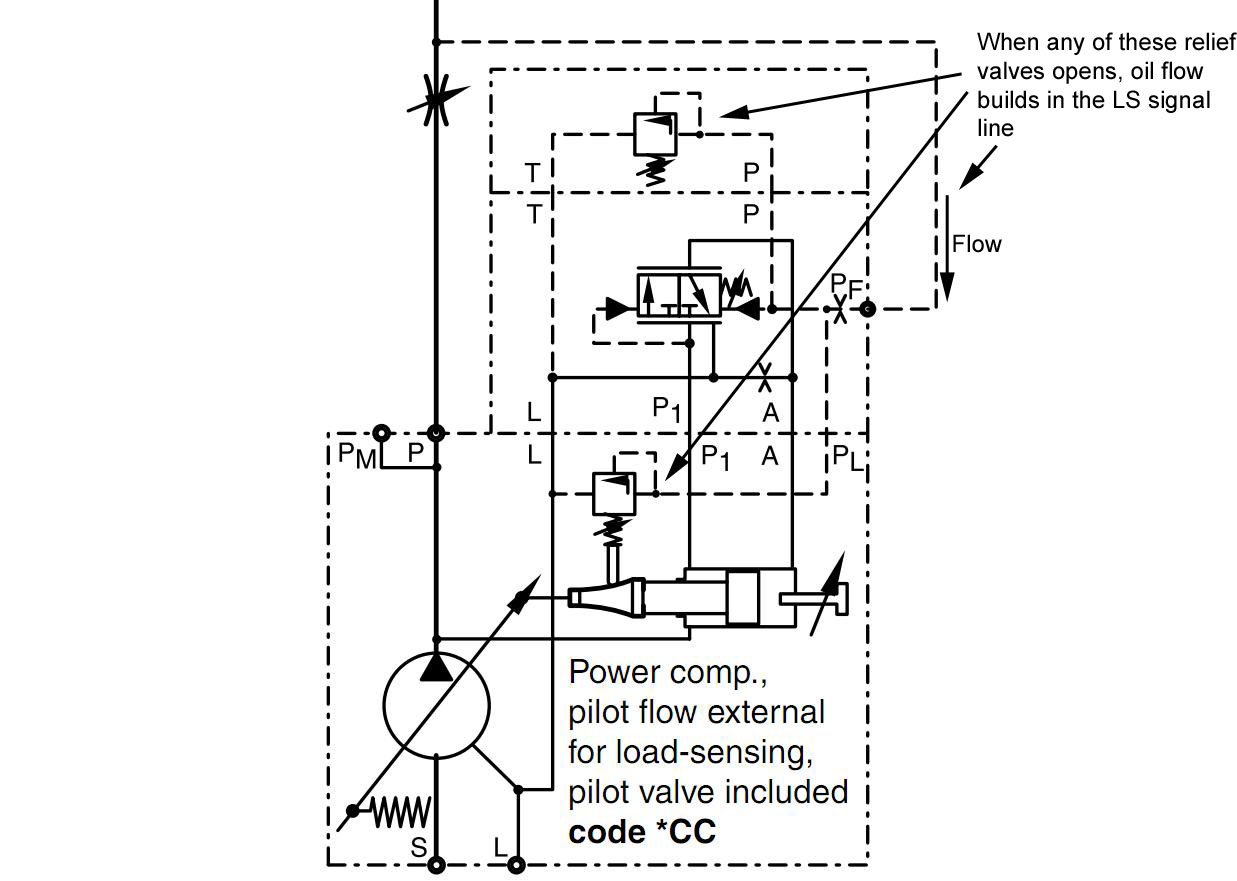
Despite seemingly mysterious, this malfunction has a very simple explanation, and if you carefully look into the operation of the pump control, you will see that it is very easy to come up with a theory that can explain all of the symptoms. This pump's control operation is based on a single spool - namely, the LS spool, which along with the natural load sensing function (keeping the constant delta P between the LS port and the pump outlet) also assures the pressure compensator and torque limiting function by means of venting the signal line through the two relief valves - one with a fixed setting (pressure compensator function), and one with a displacement dependent setting (torque limiter function).
Let us ask ourselves - what is common for both situations - when the torque limiter and the pressure compensator adjusting screws are turned out? What is that common thing that happens inside the control when any of the two adjustments is lowered? - That's right - whenever any of the two relieves kicks in - the oil in the LS line starts to flow:
It doesn't take much to imagine a condition when the LS signal gets blocked whenever a flow builds up - and the condition is - a loose particle next to an orifice, that functions like a load-drop valve, closing the orifice every time the oil flow is strong enough to lift it:
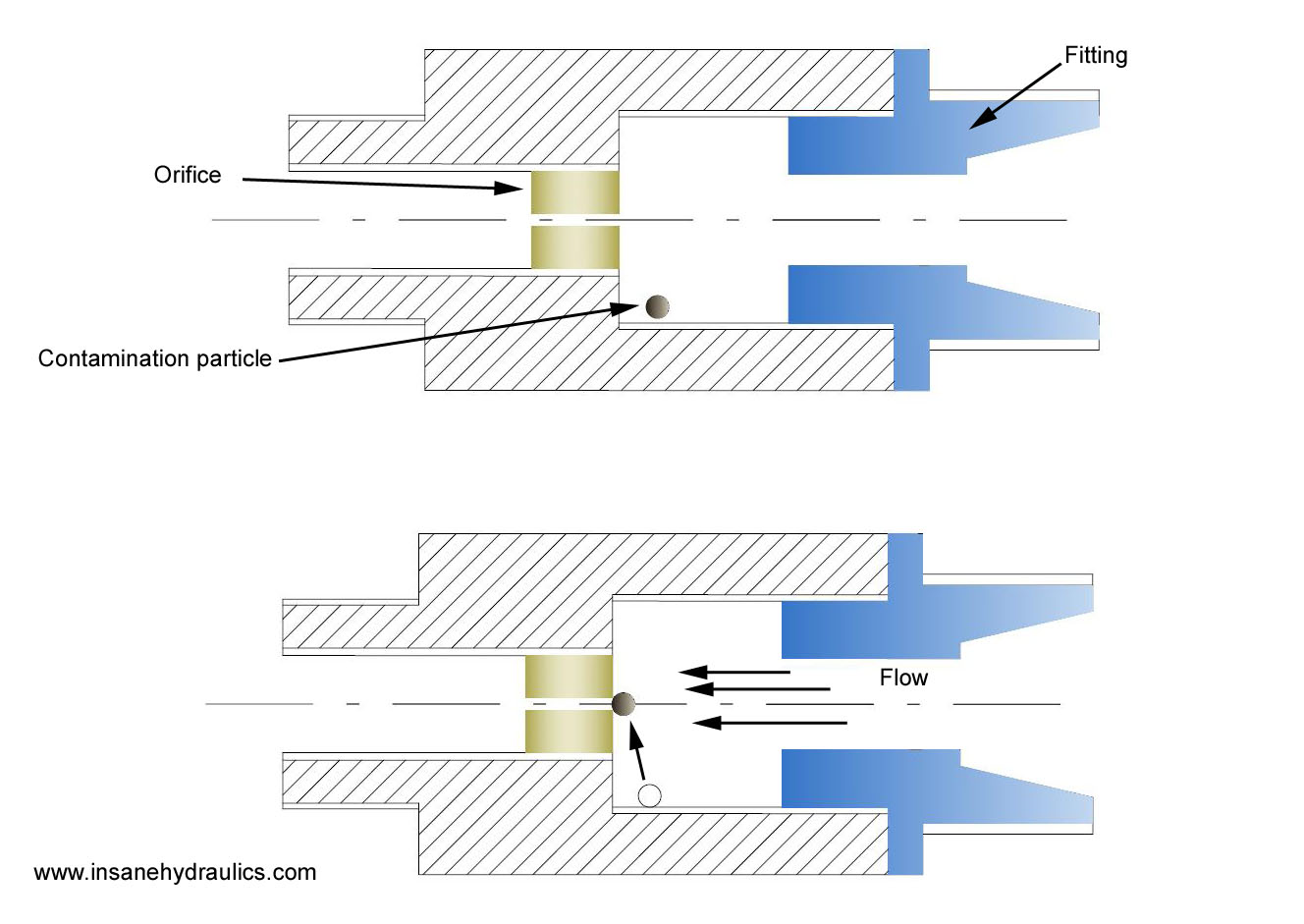
Despite having been cleaned several times, the fitting mounted above the orifice had never been removed, and since the person responsible for cleaning the parts could clearly see the light through the apparently unobstructed orifice, he assumed that it was not necessary to disassemble it. The hard particle, that got caught in the cavity above the orifice was plugging the orifice whenever a flow strong enough to lift it developed in the line. The fitting was taken out - and a small piece of hard rubber was discovered under it, and, of course, removing it solved the problem.
Troubleshooting is all about coming up with theories and testing them. And I must tell you - it was extremely rewarding for me to hear about the symptoms, and then to be able to tell what was happening and indicate exactly where to look for the problem, and to be right about it! I'm not bragging, I merely show that:
a) complete understanding of a component's operation, and
b) sufficient test data
are the two main conditions for coming up with a valid theory that has the best chance to prove right.
So, in static closed center load sensing systems, depending on the type of the variable displacement pump control, oil flow can build in the LS signal line - a fact not to be forgotten to assure efficient troubleshooting of such hydraulic circuits.