
Insane Hydraulics
Bold and audacious blog about fluid power








I've troubleshot enough hydraulic systems to know that maybe ten percent of equipment malfunctions and the consecutive production stops are caused by what I like to call "bogus" failures. By "bogus" I mean failures that are caused not by broken or worn-out parts, but rather by simple and instantly "fixable" reasons, which despite being the main reason the equipment stopped normal operation, still do not justify major interventions, like dismounting components or replacing the malfunctioning machines.
In this article, I would like to address a component, that can easily cause a "bogus" failure of a closed-loop system - namely the bypass valve. Most closed-loop transmissions are equipped with bypass valves (or the bypass function integrated into a multifunction valve) to allow towing of the vehicle or movement of the actuator in emergencies. This modest feature, when activated accidentally, can easily render a transmission inoperable, and cause a lengthy downtime and even an expensive overhaul of the loop components - not because it breaks or damages components, but because operators and often even mechanics simply forget to check the bypass position and draw wrong troubleshooting conclusions.
A couple of months ago I witnessed a plant stop production for several hours to replace the malfunctioning closed-loop power-pack with a spare one due to a partially open by-pass. The mechanics followed the "standard failure" protocol - so no one remembered to check the bypass. In the end, it turned out that all that was needed to fix the failure was tightening the small socked head screw. A lot of time and effort was wasted to replace the 500 kg power-pack. Then, afterward, a lot of money was wasted to send the power-pack to our workshop to "repair" the problem. Quite a bite for tightening a screw, don't you think?
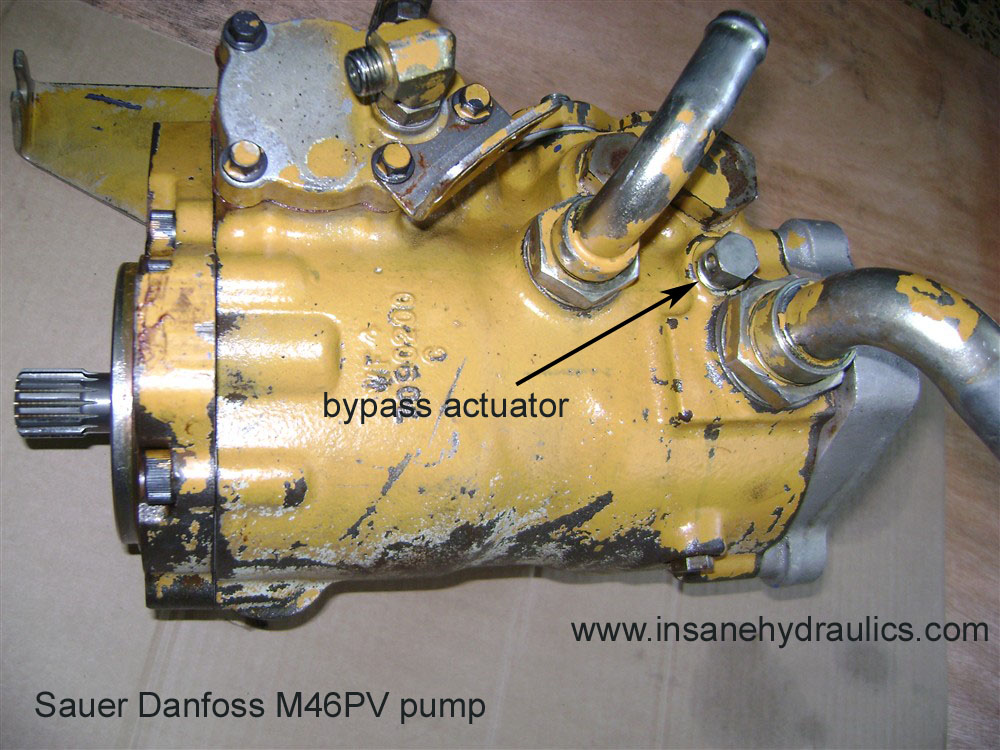
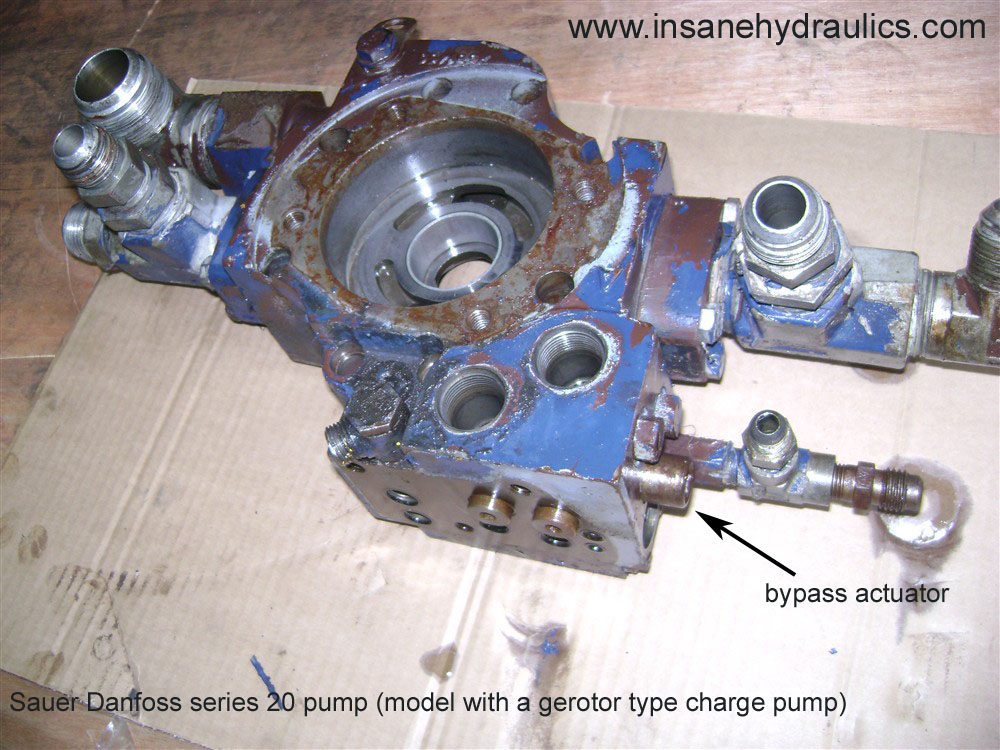
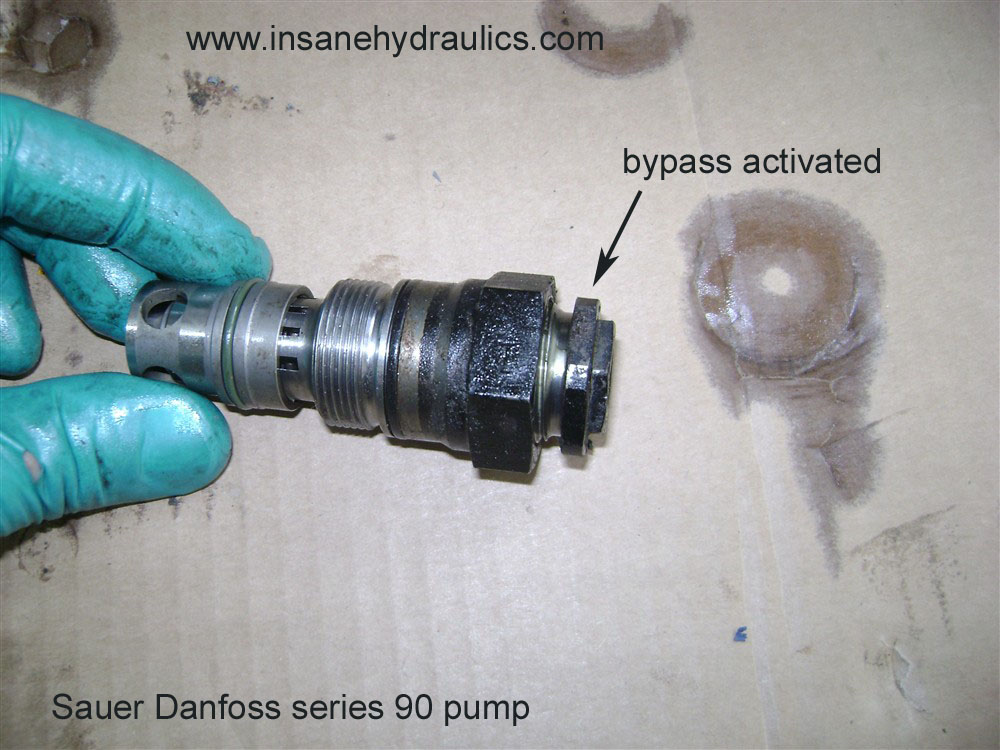
The closed-loop bypass can be built into the pump, it can also be built into an external loop flushing manifold, or it can be a simple ball valve mounted somewhere on the frame of the vehicle. To the left you can find some examples of bypass designs:
Pic. 1, Pic. 2 - Sauer Danfoss M46PV closed-loop pump.
Pic 3, Pic 4 - Sauer Danfoss series 20 closed-loop pump (the model with gerotor type charge pump). It's 2020, and if you're just starting in hydraulics, I doubt you will ever come across such a relic...
Pic. 5, Pic. 6 - Sauer Danfoss multifunction valve for series 90. The last image shows the bypass function activated.
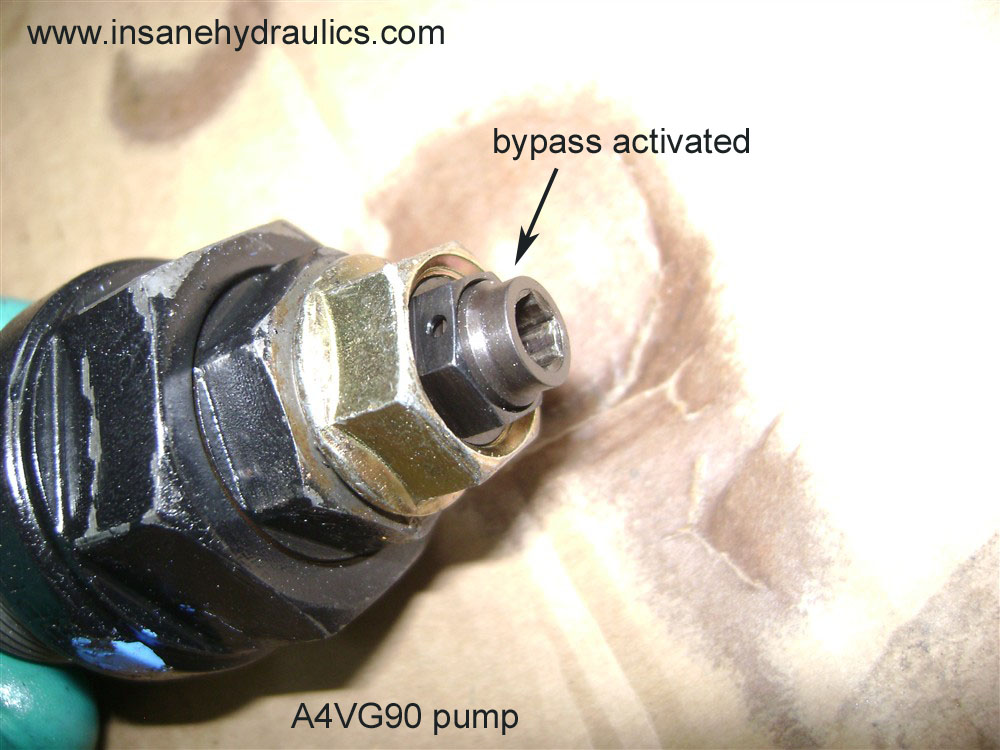
Pic. 7, Pic. 8 - Rexroth multifunction valve for A4VG90, last image shows the bypass function activated.
Pic. 9 - Rexroth multifunction valve for A4VG125, the bypass is activated by screwing the whole valve out a couple of turns
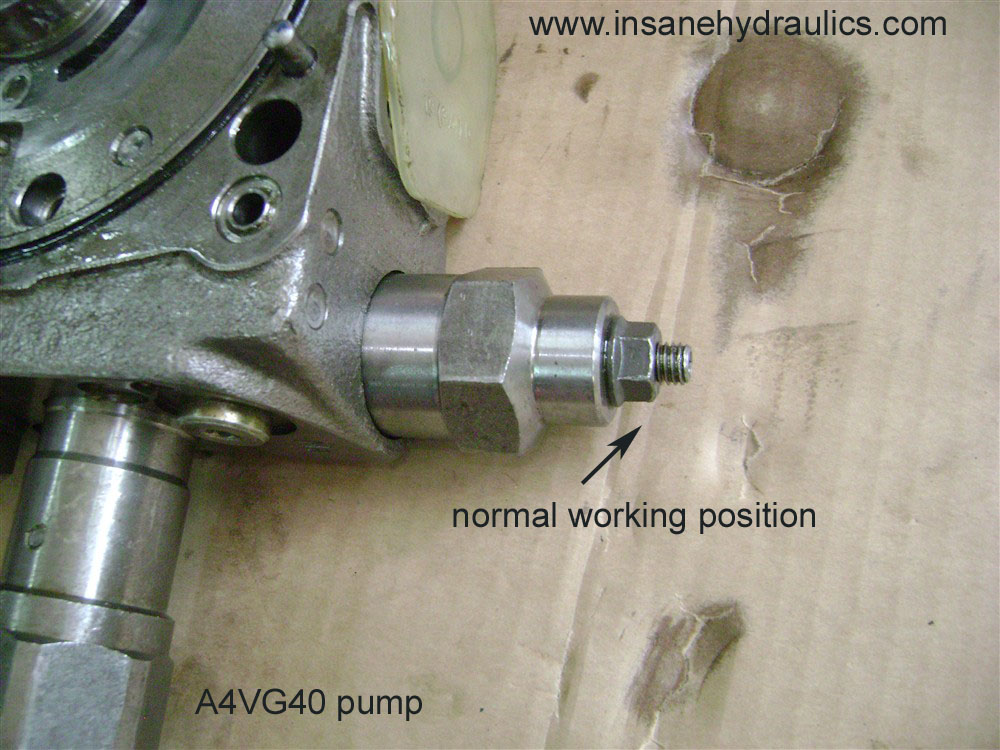
Pic. 10, Pic. 11, Pic. 12 - Fixed relief valve for Rexroth A4VG40 pump. This is a somewhat treacherous design, as one may look at the bypass actuator, and consider it a pressure adjustment screw. It does look like one, doesn't it?
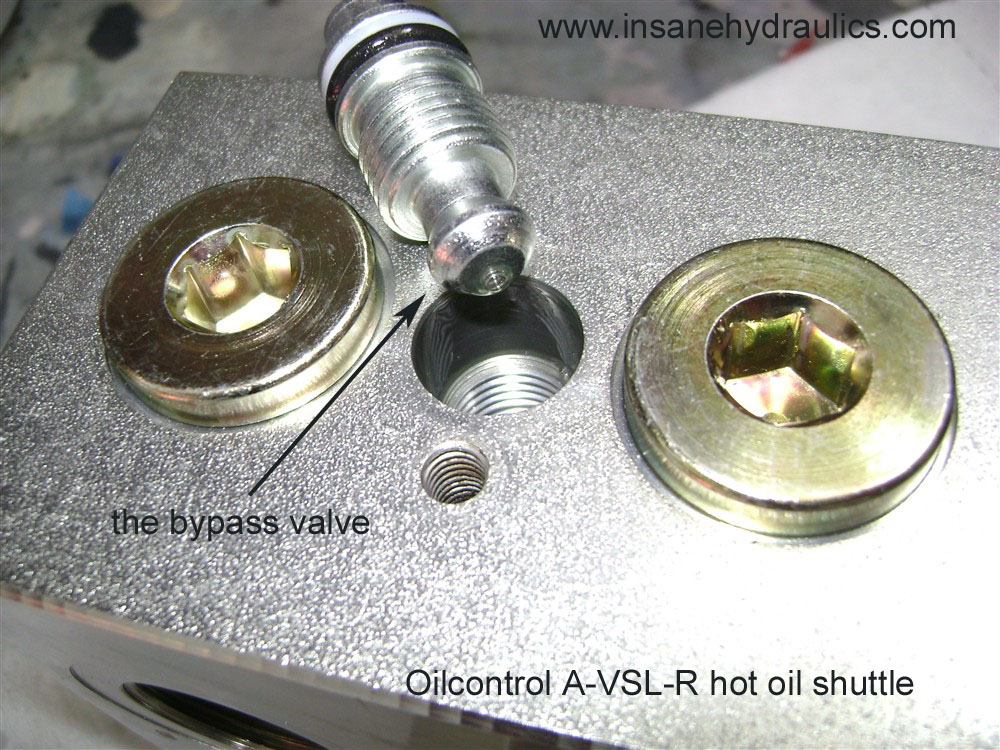
Pic. 13, Pic. 14 - Oilcontrol A-VSL-R closed-loop purge valve, with built-in bypass.
Bypassing of a closed loop in emergencies can also be achieved by lowering the setting of the loop relief valves (alternatively - removing the springs) or removing the shuttle spool from the loop flushing block. And, of course, towing can only be performed at low speeds and for short distances.
The most fundamental principle of hydraulic system troubleshooting is - check simple things first! And checking if a closed-loop transmission is equipped with a bypass valve and if it is activated for some reason is the simple one minute check a hydraulic technician should do whenever he faces a closed-loop with "not enough force" symptom.
I confess I made this mistake once, and removed and brought a closed-loop transmission over to our workshop just to discover that the bypass was open! From then on I have developed a reflex - whenever a phrase "closed-loop troubleshooting" comes up - my head gives an instant subconscious response thought - don't forget to check the bypass!
I know I'll never make this mistake again, and I hope that after reading this post, you too never will.