
Insane Hydraulics
Bold and audacious blog about fluid power
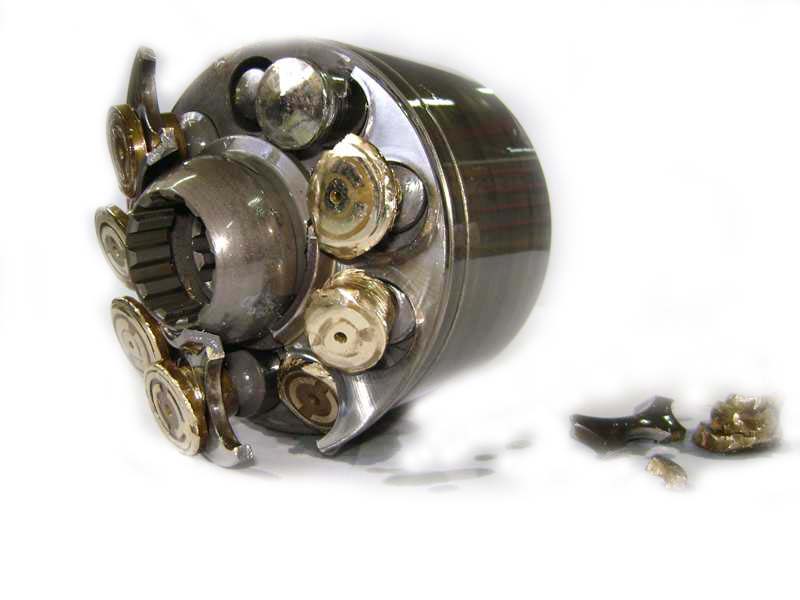
This article is about the good practice of reusing spilled hydraulic oil in a shop environment, and I will get to the point in a minute, but I would like to start with the story of an "extreme reuse of spilled oil" that I witnessed a couple of years ago. What can I say? I like telling stories.
So, a client of ours - a dredging company - was complaining about the qualtiy of our gear pumps. A couple of hundred hours was the best they could get from our standard group 3 aluminum body gear pump, which, of course, was unacceptable. When confronted with the usual questions about the condition of the hydraulic oil, the owner assured that it was "slightly used but still OK". It was obvious that the problem required investigation.
The gear pump "in question" was powering hydraulic jacks of a large split barge. For those of you who may not know - a split barge is basically a barge that is cut in the middle, with the two halves hinged at the deck and operated by two enormous hydraulic cylinders. The cargo (rocks, sand, soil) is carried in between the halves and is dumped by splitting the whole vessel longitudinally. A cool thing to look at when it is operating, by the way.
The pump usually worked for about fifteen minutes at most every couple of hours - the time necessary to split and close the hull to dump the load. Operating pressure was also low, around 150 bar, so the pump was working way below its rated capability. A gear pump is supposed to last a lifetime under these conditions, so clearly something "funny" was going on...
I discovered what it was as soon as I looked inside the oil tank and found milky and smelly fluid, which the crew was persistently calling hydraulic oil. A short conversation with the crew members revealed an astonishing "tale" of the corroded steel pipe that ruptured and dumped all of the tank content over the deck.
As it turned out, the only way to stop the small diesel engine that was driving the pump was by operating the decompressor lever that was mounted directly on it, and the powerpack was situated in a small compartment below the deck - quite a long way from the elevated cockpit, so when the engineer (finally) saw the (rapidly) growing oil puddle, it took him a good minute to sprint down several narrow flights of stairs and then run all the way to the motor compartment hatch and then down another flight of stairs to stop it, giving the "reasonably sized" pump all the time in the world to drain the tank dry.
The ruptured pipe section was quickly replaced, but there was no oil in the tank now, and the barge had to operate no matter what!
Early years of my career - the times when I was employed at a company that manufactured hydraulic equipment for industrial fishing, and spent many days on board all sorts of vessels all over Portugal - gave me the perfect opportunity to get acquainted with "men of sea" first hand, and I can guarantee you one thing - if a sailor (or a fisherman) can't find a way out of a pickle - the world has come to an end! That time was no different, and the crew quickly came up with an effective and elegant solution of gathering the spilled oil with brooms and shovels from the deck into buckets and then transferring it from buckets back to the oil tank through a piece of cloth... I kid you not!
Of course, when there's an emergency and you need the barge to be closed to navigate, I guess you might say "to hell with the pump, I want the damned thing closed", do the broom-bucket trick, get back to the harbor, and deal with the situation there... But the thing is... the predicament happened more than a year ago!!! Ever since the incident, the hydraulic system has worked with the same deck-tainted oil! No wonder the poor pumps wouldn't last. I would guess half of the hydraulic fluid was seawater, and the other - seawater-in-oil emulsion enriched with deck-type "pro-wear" additives.
The most astonishing thing was the fact that neither the owner nor the crew were anxious about the oil. Their logic was bullet-proof - the water will eventually evaporate, the particles will eventually filter out, so no big fuss here... The sudden increase in pump failure rate was explained by the low quality of the pumps, and I'm still not sure if I managed to convince the owner that the hydraulic oil was no longer in an acceptable condition.
This story is anecdotic, but I must tell you that I have seen similar attitudes among hydraulics-related businesses. I am referring here, of course, to the matter of reusing spilled hydraulic oils.
Hydraulics is all about oil in huge quantities, and it is normal that it gets spilled all the time. When you disassemble a component - the oil is spilled over the bench, when you connect and disconnect a component to a test bench - the oil gets spilled, in fact, whenever you do anything with hydraulics - there's always an oil spill. Of course, there are benches that are prepared to gather the oil spilled over them, and most of the time it is possible to catch the "runaway" oil from mounting/dismounting procedures into a tray, but there's still the question of what to do with it next.
Simply discarding the gathered oil is only viable in case of very low volumes and occasional spills, but most hydraulic shops deal with oil spills daily, so throwing the oil away can become an expensive practice, especially with the oil prices constantly growing. Reusing the caught oil, by putting it directly back into your test rig is also a bad idea because it brings along large amounts of particles washed from anything it was spilled over, and a simple filter will not do the trick - the particle contamination level of spilled/gathered oil is enormous for a single pass to work, so devising a rig for exhaustive filtering of spills is not an exaggeration.
But there's an economic alternative. A devoted tank, if designed properly, can use gravity to do most of the filtering. In that case, I would suggest a high and narrow vessel (like a drum), with the drain placed way above the bottom, a ball valve, and a bank of filters. When the drum is full, the ball valve is opened and the oil is drained slowly, leaving all the heavy particles at the bottom, and most of the fine particles in the filters. The resulting oil can then be transferred to the respective machines/ test benches in a "normal fashion". In case you wonder what "normal fashion" means - it means transferring oil with the help of your filtering cart and through the return filters via conveniently mounted fast couplings - anything less than that is not normal!
It is also very important to make sure that there are no mixtures of incompatible oils. As a rule, you can mix different viscosity grade hydraulic oils with the same additive package without consequences, but when not certain, your best bet is still to discard the unknown oil.
My point is very simple - it is not wise to throw away spilled oil if your shop generates a lot of it, but it is also unwise to re-use it without proper filtering, and no matter what solution you choose - the priority should be always the cleanliness level and not the filtering speed.