
Insane Hydraulics
Bold and audacious blog about fluid power
A call for help came from a local scrap yard the other day. An O&K rotary grabber (you know, one of them rotary excavators with a rotary grapple instead of the bucket) was "losing force" (as the client explained over the phone). Since the main pump had been recently overhauled by "yours truly", it was a matter of the utmost urgency, so I grabbed my tools and rushed to the rescue.
I always get over-excited when I go to a scrapyard. Like a kid in a candy store. You wouldn't believe how many "almost new" things can be found at a scrap yard, good for either using or smashing. I never get tired of watching one of these grabbers deal with used cars, ripping them apart and throwing them around like toys. Oh, and then there's Mr. Press, who turns scrap into cubes, and lot's of other potentially cool stuff to do, like smashing an "about to be cubed", but still drivable car into another one, or conducting a scientific experiment to find out how long an engine can run if the oil has been replaced with water. The possibilities are limited by your imagination only. An instantaneous stress relief, free of charge.
Anyway, the machine did seem to be "lacking force" as the hydraulic pump was stalling the engine whenever a rapid movement was requested. Clearly, it had something to do with the torque limiter control of the pump - a classic Hydromatik A8VO (yes, it was an O&K, so it had to be a Hydromatik A8VO), equipped with the torque limiter with hydraulic override. The possibility of overriding the main pump's torque limiter setting is a standard feature for such machines. It allows the pump torque demand to follow the engine's torque delivery at varying rpm and the overriding pilot pressure is usually controlled with an electric proportional pressure reducing valve.
After half an hour of "skillful hose pulling" (for those of you who don't know it - "hose pulling" is the universal technique, used internationally to determine hydraulic connections of "uncharted systems") I discovered that the pilot signal for the torque regulator override was coming from an electric valve, hidden under the belly of the beast. The solenoid was OK and the valve itself presented no excessive wear, however, no current was reaching the solenoid and that's why the double pump was running at its maximum torque setting, which was more than enough to stall the diesel. When I told the client the problem was electric he didn't seem to be one hundred percent convinced, so I had to find a fast way to prove my theory.
But where could I get a proportional electric signal on the spot to make the valve work? Wait a minute, it's a scrap yard, you can build anything from scrap! The coil's resistance was about 25 ohm, which suggested around 1 A tops, so I knew I didn't need a precise low current regulator, which made the challenge easy. What I needed was a current source (a couple of car batteries), a potentiometer (a dashboard light dimmer from a Volkswagen), a current limiter to protect the circuit (a bulb from the same Passat's tail light, which also served as a perfect visual current indicator), some wires (lots and lots of these around) and that's about it. To reach the coil operating current band and nice proportionality I had to experiment a bit with the bulb size and the input voltage (one vs two 12V batteries in series).
And you know what? It worked! As the solenoid current was increasing, which was clearly indicated by the glowing of the bulb, the pilot pressure was increasing and the torque limiter setting of the pump was decreasing. The engine was no longer stalling! Not only the client was convinced, but he also wanted to install the new "power management system" for good. Talk about scrap yard repairs!
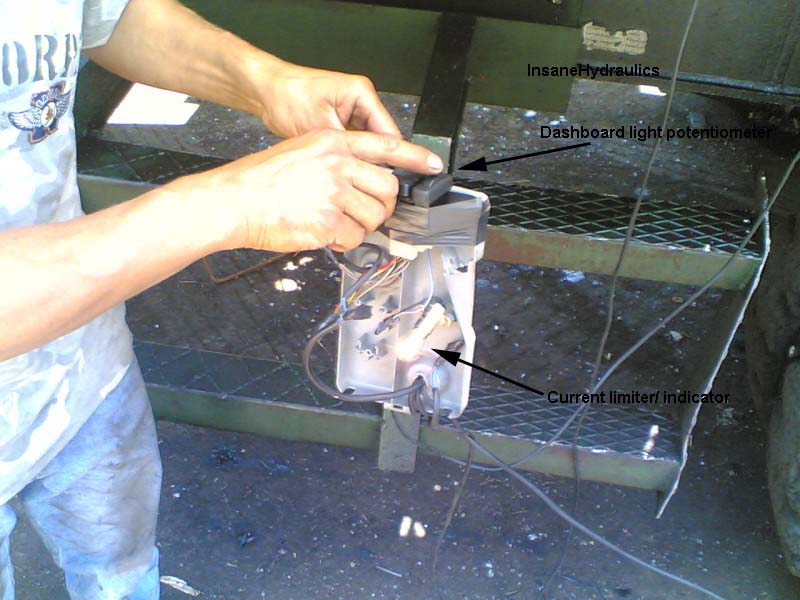
The owner did call an electrician, though, who discovered a busted electronic control module. As a temporary solution, the dimmer was set to lower the pump's torque demand to the point where the machine would be able to operate with the engine at normal operating speed (it would still stall it at low rpm), and the grabber worked for several weeks till the new module arrived. I heard it was pretty expensive.
Seeing is believing, my friends, seeing is believing!
P.S.
It must be said that this failure is very common. Virtually all rotary excavators and excavator-based machines use the torque limiter control with override in their pumps, and all of them use an electric proportional reducing valve to pilot the torque controller override. The valve can be either built-in or external to the main pump, but the symptom is always the same - the engine either stalling or bogging down, often accompanied by puffs of black smoke coming out of the exhaust. Theoretically, it can be the other way around as well (if the valve has a negative characteristic)- the system becoming too slow and "light" on the engine. Be it as it may, the quick tip is - if you face such a symptom, find the valve and check the wiring and the coil, and then the current. Just because. You wouldn't believe it if I told you how much an unplugged coil can cost in pump repairs...