
Insane Hydraulics
Bold and audacious blog about fluid power
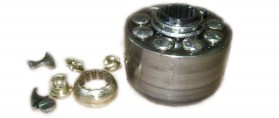
Even though this troubleshooting episode happened a long time ago, it still carries a good point.
A client dropped by our workshop with an open-loop pump from a forest crane. I don't remember the exact model of the forwarder now, but back then it was still a Timberjack, and the pump was the good old A10VO series 3x. I think it was a 100, maybe a 140. The man was convinced that the pump was damaged. The main symptom was the crane movements becoming slow as the oil heated up. The man had worked with hydraulic machinery since forever, and was pretty certain that the problem was caused by the pump's low efficiency, with the internal leakage aggravating with hotter and, therefore, more fluid oil - something he'd seen countless times before. A valid assumption, if you ask me.
The pump was disassembled and, to everyone's surprise, no serious damage or wear was found, so it was reassembled and tested, presenting adequate efficiency and good controllability on the test stand. However, the next day, when the pump was reinstalled on the machine, the crane showed the same old symptom - movements slowing down as the oil was heating up, becoming eventually so slow that any operation was impossible.
The pump was dismounted, brought to our workshop, stripped down, and yet again nothing wrong beyond normal wear was detected. Once again, the pump was reassembled, retested, and showed good efficiency and correct control function (pressure limiter and load sensing). When the pump was remounted on the machine nothing changed, the crane movements kept on slowing down as the temperature rose. This time the man asked if I could "take a look", so I grabbed my gear and went to see what was going on.
The hydraulic circuit of the crane was of the classic closed center load sensing type. The main directional control valve was equipped with electric proportional controls. Comparing the pressures at the pump's outlet and the load sensing line showed a steady delta P of 30 bar when the movements were getting slow, even when the joystick was tiled all the way. This could only mean one thing - something was throttling the oil between the pump's outlet and the load sensing signal line. The most obvious explanation for this would be a partial stroke of the DCV spools.
Further "digging" showed that the pilot pressure reducing valve, supplying oil for the proportional solenoids, was malfunctioning, causing the pilot pressure to drop significantly with the rise of the oil temperature. There was simply not enough pilot pressure to make the spools go "full stroke", and the pump's load sensing control was sensing the pressure drop of the partially opened spool and compensating for it with the reduced flow, as it should!
To tell the truth, I don't remember what exactly was causing the valve to malfunction, it may have been a clogged pilot strainer, but I wouldn't bet my life on it now. I do remember that the problem was solved "on the spot" and the crane's normal operation was restored.
If you look more carefully at this case, you'll see that there is a major flaw in the initial conclusion that the problem was caused by the pump's low efficiency. Indeed, it is absolutely plausible for an worn or damaged open loop pump to be able to perform much better with cold and more viscous oil, and fail to produce sufficient outlet flow with hot and more fluid oil, But, in such situations another major symptom would have been detected - overheating of oil! When we loose significant part of flow to leakage, all the energy, spent to produce it, will be transformed into heat. So, if the pump indeed was worn or damaged, and the significant loss of speed was connected to leakage losses, the oil temperature would have been much higher than usual.
In this case, the problem was starting to occur when the oil temperature was only getting close to the normal operating temperature, without further overheating, thus putting the low-efficiency theory under question. I know this because the machine was equipped with an oil temperature gauge and an alarm, going off at 70 C, which is common for Timberjack/John Deere foresters and is something I consider a "must" for any piece of hydraulic equipment. The alarm never went off.
I am not mentioning the stable delta P here, because the owner based his diagnostics on what I like to refer to as "human-readable" symptoms - i.e. symptoms that can be perceived without any test gear.
This is just another example of how important it is to know what the normal operating oil temperature of your hydraulic system is. It is, by far, the most important troubleshooting reference point.
This is also a good example of how precipitated troubleshooting conclusions cause unnecessary downtime. It is always a good practice to double-check your "hunch-based" theories whenever possible, and, maybe, take a pressure reading or two while you're at it!