
Insane Hydraulics
Bold and audacious blog about fluid power
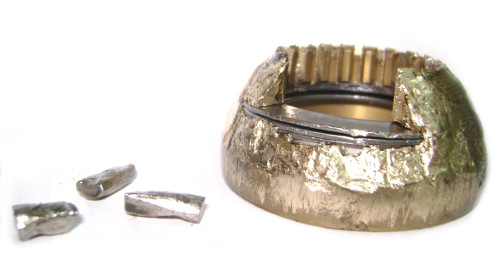
The following industrial tale is another good example of an extremely bad example.
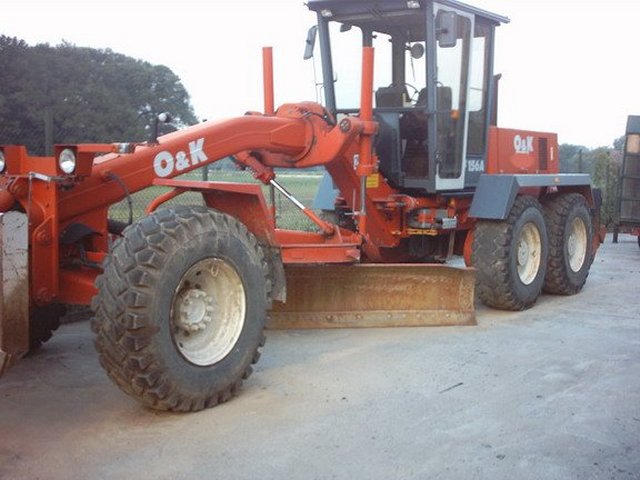
This is a true story, personally witnessed by me, and its main characters are an old O&K grader (similar to this one, picture taken from the web), and a team of "prominent experts" from a well-established earth-moving equipment reconditioning/reselling business.
As the oil temperature increased, one of the two hydraulic cylinders that raised the blade would become progressively "heavier", and eventually would stop lifting the blade altogether. The other cylinder operated normally.
A pressure gauge was used to measure the pressures in both cylinders. The pressure on the "good" side read 120 bar, while the "bad" side didn't go higher than 50 - clearly insufficient. To find out the root cause a series of theories were tested (read "the fun begins now!").
Theory one - the cylinder has damaged seals, therefore the excessive internal leakage doesn't allow the pressure to go higher than 50 bar.
Attempted solution - The cylinder is replaced with a new one, the malfunction continues...
Why is this wrong? - First of all, leaking piston seals generally do not cause "loss of force"! If, however, the internal leak between the rod and the piston end were so big that it would indeed become a pressure limiting factor (even with the relatively low oil flow, this would equal removing the piston seals completely) another symptom would appear - the cylinder wouldn't be able to hold the blade in the air, since the load was being held by the rod side of the cylinder (rod facing down), and this was never detected.
Theory two - the cylinder is equipped with an over-center valve, and it is suspected that it has an internal leak causing the loss of pressure.
Attempted solution - Since both cylinders use the same type of valve, the valves are interchanged to check if the problem changes sides as well - the malfunction continues on the same side...
Why is this wrong? - First of all - the internal design of the valve made it practically impossible for such an internal leakage to exist (or to be big enough to cause such a significant loss of pressure), but even if it were possible for such a leak to exist, it would have been much easier and much faster to plug the hoses and check if the pressure normalized instead of interchanging the two valves (same goes for the cylinder, by the way). Also, if the leak existed, other symptoms would be present, like the characteristic noise and local overheating.
Theory three - someone remembers that once before a similar problem occurred on another alike machine, and the problem was solved by replacing the worn-out pump.
Attempted solution - Orders are - to dismount the hydraulic pump and send it to a local hydraulic workshop for an overhaul. One small mistake is made during the process - the pump that gets dismounted is actually the closed-loop pump driving the front axis of the grader...
Why is this wrong? - Well, this is ALL wrong! Clearly, the person responsible for removing the pump from the machine was absolutely unaware of what closed loop and open loop circuits are. In fact, he didn't even bother to follow the pressure hoses, and simply removed the first hydraulic pump he saw.
The closed-loop pump was sent to our workshop, and, as requested, got an overhaul (minor lapping and new seals). When the client re-mounted the pump on the machine the problem, of course, continued, so the troubleshooting process went on...
Theory four - since there are no doubts now about the pump's condition, the directional control valve must be the problem.
Attempted solution - The DCV is removed from the machine, and is replaced by one from an equal machine that is known to work fine, which takes a tremendous amount of effort and time! The malfunction continues...
Why is this wrong? - The DCV was replaced on a "hunch", without performing any tests whatsoever to confirm its malfunction. This is something that should never happen. Having no test gear is not an excuse. Hell, even the good old and ugly (and unsafe) "disconnect the return line and have a look" test would have been better than spending a couple of shifts swapping the bulky multi-section DCV without knowing for sure that it's faulty.
Theory five - it can only be the damned pump then!
Attempted solution - Call the guys who repaired the pump! They obviously screwed up! So, our repair shop is contacted and is informed that the recently overhauled pump "is not working..." Since it is a warranty claim (i.e. a matter of honor) yours truly is immediately dispatched to see what is wrong. At that point the grader has already been out of commission for about a month - as you can imagine, removing components from the machine that big involved certain amounts of time and manpower, and the consecutive tests required dislocating the machine to a worksite and then bringing it back, which was all but simple.
When I got to the shop and confronted the mechanics with the idea that it was very unlikely for a closed-loop pump to drive such a circuit, one of the mechanics remembered that there were "some other pumps" installed on the grader. Genius! Following the pressure hoses revealed a triple gear pump. Very happy with the "discovery" the foreman was already giving orders to replace the pump with a new one and got notably disappointed when I told him that it would be better to first check if the pump indeed was faulty before dismounting it.
The next thing I did was the good old touch-the-gear-pump trick. I shoved myself into the small square opening in the frame under the operator seat, put my hand over the gear pump, and told the operator to pull the "troublesome" lever - as expected the pressure rose to the 50-60 bar and stayed there and I was feeling no heating of the pump's body whatsoever - the pump's body temperature remained stable. I then suggested the man to look for malfunction elsewhere, as the gear pump was missing the main symptom of a worn-out gear pump - the local overheating. Still very suspicious about my test and conclusion, the man told me that I "could give it a try"...
It took me another three or four hours to check the whole circuit. Most of the time was spent doing the "hose pulling exercise" because, as always, no hydraulic schematic was around, and in the end, I narrowed the malfunction down to a manifold, mounted between the DCV and the pumps. The shop foreman got even more suspicious when I told him that all of the hard "troubleshooting" work he did for the last month was re-done by me during the last four hours and that the pressure loss was being caused by internal leakage inside the manifold, which could be caused by a number of reasons, and since there was no hydraulic schematic, the manifold should be removed from the machine and inspected (or better - back-engineered).
When I disassembled the manifold on-site, I discovered that it was housing two flow limiters, and two piloted logic elements, but I didn't see any "viisble" damage, like missing seals, broken seats, or clogged orifices. At this point, I told the man that the manifold didn't present apparent failures, and to reach a definite conclusion I would need to take it to our workshop to analyze it better and run some "wet tests" on our test bench. The man disagreed - he was sure that since no visible damage was present - the manifold was OK. He insisted on re-mounting it on the machine to "see what happens", and do the necessary tests with the manifold mounted on the grader since he couldn't afford "wasting time studying components". All my attempts to reason with the man were futile...
Why is this wrong? First - since no changes were made to the manifold, most probably it would remain in the "malfunctioning state", so simply re-mounting it on the machine "to see what happens" was an illogical waste of time. The manifold was heavy as hell, and it took good two hours and two mechanics to put it back and reconnect all the hoses. Second - back-engineering of an unknown component is not a waste of time! You can't troubleshoot or fix something you don't know the function of! Third - it was virtually impossible to conduct any sort of productive test due to the very restricted access.
After all this effort, the manifold was back in its place and (I wonder why?) the problem remained. After seeing that it was virtually impossible to do anything with it in place, I told the man that there was nothing else I could do in those conditions. Since there were two equal machines in the workshop, I advised him that the only "fast" way to confirm my theory and put this particular machine back in service would be through replacing this manifold with the one from the other (operational) machine.
When the bulky valve combination got replaced (for the last time) - the problem disappeared! Finally, I got the permission to take the malfunctioning manifold to our shop. It took me six hours to find and fix the problem - it turned out that one of the logic elements had an excessive internal leakage in the dampening section, which caused the area of the section to be excluded from the hydraulic balance, and a simple slotted shim increased the flow to the section compensating for the leakage and solving the problem.
Resuming all of the above in one sentence - a simple and relatively easily identifiable hydraulic problem, that could have been diagnosed and solved in two eight-hour shifts tops (or a single sixteen-hour shift), took over a month to be resolved, caused tons of unnecessary expenses, and it all happened due to incompetent and illogical troubleshooting and lack of very basic industrial hydraulics knowledge.
So, basic hydraulics knowledge coupled with a logical approach to troubleshooting is GOLD!